The Thom Hartmann Program - Aug 30th 2018

By louisehartmann
It seems it's all racism, all the time w/the GOP...Neo-Nazi robocall hits Iowa on Molly Tibbett’s murder: “KILL THEM ALL. ” Richard Wolff drops by about the National Debt. Is it a disaster or an OK thing? Also - Trump & The National Enquirer - Is the Economy Here To Serve Us Or Are We Here to Serve the economy? Has America Become a "Grifter" Country? Check out our short podcast today https://www.thomhartmann.com/hartmann-report-podcast
Thom
Comments


#2
HotCoffee, You are correct but reflecting back over the last ten years, there were many that really disliked Obama and criticized his every move but there was no where near the out and out hatred that is being pumped out by the leftie/socialists. It is very east to prove that by going to any political forum and just roll back in their archives to 2013 era. Sure, hard core conservatives Obama hard but by todays standards they were throwing marshmallows at a tank. These lefties now are beyond sanity.
I really don't get too excited about the election outcome tomorrow because as President, Trump will manage through all the fodder thrown regardless of who is in power. Remember he has the veto pen and of all people ever to sit in the White House, Trump is not afraid to use it as much as he feels necessary.
If I make a gut feel prediction, it will be the republicans keep both the house and gain in the senate, but after the miserable job they did supporting Trump in his early days in office I really don't think they deserve the chance. Forty of them not choosing to re-run for their office is very telling and good riddance in my book.
Regardless, it's all fun anyway.
#3
DianeR,
I really hope we keep the house so Tom Fitton, Daryl Issa, Sara Carter, John Solomon, et al can continue to expose the witch hunt, The Dems would crush it. If we keep the house it will be CHECKMATE !
I don't think we will know the results for a week or so.....Ca. mail in ballots only need to be mailed by tomorrow midnight and will be counted all week as they come in.
You're right though...it is fun!

#4
So ...YES! ...we are in agreement:
It is quite obvious that neither of you sad clowns read any of Thom's -- what you call -- "crap."
You love to brag, as some whack-job badge of honor, about your hard-won, stubborn, willful, and deep-seated ignorance yet whine when confronted with Thom's actual words, insightful reflections of actual history, and the meticulously researched, actual sources upon which his knowledgeable and widely respected thoughts are based -- not the mish-mash jumble of revisionism cranked out by the fomenting far-right fringe upon which Trump trolls' totally worthless opinions are based.
And that, of course brings up the standing question no Trump troll will answer honestly on this site ("honest" being a concept beyond their capacity):
"Why the fack are you on Thom's blog in the first place if you don't read him, you can't stand what he says, you wallow with pigs in the mud on the wrong side of history, and you hate all things liberal, progressive, and/or Democratic?"
Never mind; don't wanna hear it; had enough of your goddamn lies!
And so have the American people!
BTW, the definition of "worthless opinion" is one based on lies , hate, fear, anger, and bigotry, which deplorable, in the basket, Trump Republicans, such as your miserable selves, hold in spades.
The truth of Thom's words is the polar opposite of all that nonsense and gibberish.
Every word regurgitated out of your lying, racist, filthy mouths is nothing but the delusional hogwash disseminated through billionaire-sponsored, wing-nut think tanks and spoon fed to (at least) 62 million gullible, low-information voters.
Sleep well, smelly little trolls, for tomorrow's doom and gloom looms, and you'll need every ounce of self-absorbed energy to cushion the blow of shock and despair.
#5
HotCoffee, look at it this way, the Republicans keep the house the incredible business cycle rolls along and continues to grow. The dems take the house and everything stagnates proving President Trump was right all along setting him up for re-election in 2020 and along with him, a bunch of republicans that will promise to instill sanity to the likes of Mad Maxine Waters and whoever the dems choose to run the house.
Either way I see the conservatives holding all the cards because there is no way if the democrats take the house that a great many of them will not vote with the republicans as they always have in the past. They are now and always have been a dumpster fire.
Tomorrows duty, vote first, a large glass of wine later.
#6
DianeR,
Federal Judge Releases Benghazi Evidence – Hillary Goes Into Complete Panic
It appears that it’s time for Hillary Clinton to “come to heel.” That massive closet full of skeletons she’s thought was locked up has been swung wide open as a brave federal judge released the Benghazi evidence we’ve all been waiting on.
Hillary may have thought she was above the law, but these heroes she ignored who died fighting because of her negligence deserve justice.
Fox News reports:
In a combative exchange at a hearing Friday in Washington, D.C., a federal judge unabashedly accused career State Department officials of lying and signing “clearly false” affidavits to derail a series of lawsuits seeking information about former Secretary of State Hillary Clinton’s private email server and her handling of the 2012 terrorist attack on the U.S. Consulate in Benghazi, Libya.
U.S. District Court Judge Royce Lamberth also said he was “shocked” and “dumbfounded” when he learned that FBI had granted immunity to former Clinton chief of staff Cheryl Mills during its investigation into the use of Clinton’s server, according to a court transcript of his remarks.
“I had myself found that Cheryl Mills had committed perjury and lied under oath in a published opinion I had issued in a Judicial Watch case where I found her unworthy of belief, and I was quite shocked to find out she had been given immunity in — by the Justice Department in the Hillary Clinton email case,” Lamberth said during the hearing.
more @
https://rwnofficial.com/judge-releases-benghazi-evidence-hillary-panic/
#7
DianeR,
I have to admit I did like them back when JFK was the P*ssy grabber!
I've already mailed mine in....A week ago.
'll match your wine with my MJ drenched brownie and a hot cup of coffee...cheers!
#8
So to both of you smelly old geebags, have a bleeping good bleep tomorrow while sucking the big one...
#9
#10
In the modern age, Hitler of course was the worst of all fascistic megalomaniacs.
During the same era of state-sponsored prejudice, however, religious bigotry, racism, hate and fear tore other countries apart with similar entrenched mindsets at the pinnacle of power.
#11
DianeR,
I'll be back later!
#13
Meanwhile, back to a much more interesting read than random troll droppings:
3/18/18 - Alternet
Could walking be the solution to your physical and mental health problems?
By Thom Hartmann:
Walking is a simple way to improve your physical health and encourage creativity.
Editor's Note: The following is an excerpt from the book Walking Your Blues Away: How to Heal the Mind and Create Emotional Well-Being by Thom Hartmann (Park Street Press, 2006). In the book, Hartmann explains how walking allows people to heal from emotional trauma. When we walk, we engage both sides of the body, simultaneously activating both the left and right sides of the brain. Hartmann explains that both hemispheres of the brain join forces through the bilateral therapy of walking, in order to break up the patterning of a traumatic experience that has become "stuck" in the brain.
Walking for creativity and problem solving
"The legs are the wheels of creativity." - Albert Einstein
Creativity and problem solving are psychologically similar processes. Both combine a linear approach-how do I get from here to there?-with the need to randomly access memories and ideas that may, in a linear world, seem completely unrelated.
One of the unique hallmarks of bilateral activity is that it gives access to the whole brain, making walking and other forms of bilateral work/play useful for enhancing creativity and problem solving. Resources and strengths, helpful learnings and experiences that date all the way back from childhood are available when walking, and can be brought to bear on current problems or creative endeavors.
Walking is a grounding experience, a step-by-step, moment-by-moment contact with the earth. Whether by some mystical force or some as yet unexplained psychological phenomenon, perhaps deeply rooted in our genes and stretching back over millions of years of evolutionary ancestry, feeling connected with the earth produces a liberating experience for most people.
Walking also provides us with a break from the state of normal everyday existence. Looking at the same walls, the same furniture, the same place and people often anchors us to a particular state of mind. When we go out for a walk, that state is broken, and new states of mind and emotion provoked by new sounds, sights, smells, and sensations offer access to new ways of knowing and understanding ourselves and our problems or opportunities.
The process for walking to solve problems or encourage creativity is straightforward. Decide on the issue you're going to bring to the walk, whether it's solving a business problem or figuring out how to finish a painting. Then, while walking, keep returning your mind to that specific issue, at the same time allowing it to freely roam in the intervals between your internal mental reminders. Letting your mind wander "randomly," yet at the same time "intentionally" bringing it back to the issue/problem at hand as often as you remember to, provides the space for both conscious and unconscious creative processes.
In his 1888 autobiography, Ecce homo, the famous German philosopher Friedrich Nietzsche tells the story of how the concept for his masterpiece Thus Spoke Zarathustra came as he was walking-something he did throughout his life when in need of inspiration. Nietzsche wrote down the core concept of the book during a walk in 1883, and added "6000 feet beyond man and time." A few weeks later he sat down and wrote the entire first part of the book in ten days.
In Ecce homo Nietzsche writes:
"That day I was walking through the woods along the lake of Silvaplana; at a powerful pyramidal rock not far from Surlei I stopped. It was then that this idea came to me.....
Mornings I would walk in a southerly direction on the splendid road to Zoagli, going up past pines with a magnificent view of the sea; in the afternoon, whenever my health permitted it, I walked around the whole bay. It was on these two walks that the whole of Zarathustra One occurred to me, and especially Zarathustra himself as a type; rather he overtook me."
Describing how walking would activate his creative processes and cause concepts to fall into consciousness fully formed, Nietzsche added: "One hears, one does not seek; one accepts, one does not ask who gives; like lightning, a thought flashes up, with necessity, without hesitation regarding its form-I never had any choice."
Another quick technique that can aid in both problem solving and enhancing creativity is to ask the creative part of you to participate in the walk. This is essentially what Nietzsche did-whenever he walked, he fully expected the creative part of his mind to make an appearance. Although this may sound a bit odd, try this simple exercise right now and you'll discover how real and useful it can be.
After you finish reading this paragraph, close your eyes, and ask yourself, "Is there a creative part of me in here?" Do it now.
Nearly everybody will hear or sense some sort of a "Yes" answer to that question, because we are complex beings with different internal mental and emotional aspects of ourselves that have taken responsibility for different tasks in our lives.
When you're going to walk for problem solving or for encouraging creativity, before you go on the walk ask the creative part of you if it will participate in the process by tossing out possibilities and helping you see or hear or get new ideas as you're walking. You may also want to ask if there's a part inside you that has taken responsibility for the creative project or problem you're trying to solve. When that part of you agrees, ask it if it is willing to receive some help from your creative self. Again, the answer is almost always, "Yes!"
Once you've accessed both of those parts of yourself and put them in touch with one another, go for the walk.
Walking to create a motivational state
"People often say that motivation doesn't last. Well, neither does bathing-that's why we recommend it daily." -Zig Ziglar
In his 1937 classic Think and Grow Rich, Napoleon Hill shared the secret that steel baron Andrew Carnegie used to transform himself from a penniless Scottish immigrant into one of the richest men in America. That secret, Hill reveals, is to bind a clear vision of a future you want (in the case of his book, a future filled with riches) with a strong and positive emotional state.
Hill wasn't the first to observe how motivational states work. Three centuries before Christ was born, Plato wrote Protagoras, a story of a discussion between the sophist Protagoras and Plato's teacher, Socrates. In this classic example of Socratic dialogue, the two men struggle with questions such as "Why do the sons of good fathers often turn out ill [or good]?" and "Surely knowledge is the food of the soul?"
Socrates speaks directly to motivation and results, asking Protagoras, "And what is done strongly is done by strength, and what is weakly done, by weakness?" Plato tells us: "He [Protagoras] assented."
Following a lengthy discussion of how people are raised and what they learn, one of the conclusions the men come to is that people are more strongly motivated by what they consider close than by what they consider far away, be it in distance or in time.
Or, as King Solomon is purported to have said a thousand years earlier, "When desire cometh, it is a tree of life" (Proverbs 13:12).
We are all, always, choosing between moving toward pleasure and moving away from pain. Every single minute is filled with one or the other: we're never neutral.
Moving away from pain is the "hotter" of these two, but strategies that move us toward pleasure provide long-term, compelling, inexorable motivation. A good analogy is that moving-away-from-pain strategies are like lightning, producing rapid but short-lasting (and sometimes painful) jerks away from what we fear, whereas moving-toward-pleasure strategies are like gravity-inexorable, continuous, and ultimately a means for bringing us to our goals.
The key to making powerful moving-toward-pleasure choices and connecting them to our goals is anchoring a positive vision of the future we want with a powerful positive emotional state. Motivational teachers over the years have proposed many fine techniques to accomplish this-putting up note cards with motivational slogans on mirrors and refrigerators, reading a motivational statement every morning and evening, listening to tapes of motivational speakers regularly-but all eventually bring us to the same place: creating a powerful vision of the future that is bright, shining and desirable.
Using the Walking Your Blues Away technique, you can build and anchor strong positive motivational states. The process is quite straightforward:
- While walking, visualize possible future states.
- Select the one that seems optimal and that you want to focus on.
- While you're walking, hold the visualization in front of you, at whatever distance or location seems most comfortable and appropriate.
- While walking and holding this future ideal, remember times in the past when you were able to accomplish similar things or had great successes or desires fulfilled.
- Allow the emotional state of the positive memories to fill and suffuse the hoped-for future state.
- See yourself in the picture clearly-how you're dressed, what you're doing, how you're standing.
- When the positive future state is clear and makes you smile, stand up a bit straighter and feel powerfully good. Create a word, sound, gesture, or posture to anchor the state.
- Repeat the anchoring reminder a few times until it once again brings up the feeling of success in your body, then finish your walk.
Having done this, you can then put up reminders around the house-the cards on the refrigerator and mirrors with a word or two that remind you of your future goals. Whenever you see these, you then assume the posture and make the sound or gesture that re-accesses that state, remembering your goals and letting the full positive intensity of the enthusiastic emotion fill you.
Over time-often over a surprisingly short time-you'll discover that you are achieving your goals. Programming your unconscious mind like this, you'll begin to see opportunities and chances where before you would have missed or ignored them. You'll find yourself moving toward your positive future as if it were drawing you in the same inexorable straight line that drew Newton's apple from the tree.
Walking to improve physical health
"Walking is man's best medicine." - Hippocrates
Walking may well be the best single exercise there is for human beings. We're designed to walk. Through most of our history, we walked several miles a day in search of food, water and firewood-as indigenous people do to this very day.
Unlike running, walking rarely causes injuries. It is infinitely variable-you can walk fast or slow; uphill, downhill or straightaway; you can carry small weights in your hands or strapped to your ankles to increase the cardiovascular effect; or you can simply walk comfortably and freely.
Not only are our bodies designed to be able to walk, they require walking to work right.
Walking exercises the heart and lungs and stimulates the pumping of the lymphatic system. There are more than 600 lymph nodes in the body; they are an essential element of our immune system. But unlike the circulatory system, which has a heart to push blood through our veins and arteries, the lymph system relies on gravity. Every time you take a step, your entire lymph system is stimulated and the flow of lymphatic fluids increases.
Hundreds of studies have found that people who walk for at least 15 to 30 minutes a day are healthier than people who don't. They contract fewer diseases, are less likely to get cancer, have lower risks of heart attack and stroke, and have better bone density.
Walking improves digestion and decreases the risk of intestinal cancers, validating the old Chinese proverb that suggests a person take a walk after eating a meal, counting one step for each time you chewed during the meal. Regular walking reduces the risk of type II diabetes and reduces the insulin dependency of people who have already developed that disease. It recalibrates the body's energy and energy-storage (fat) systems, so the body becomes trimmer and more efficient.
Walking helps the kidneys stay clean and clear; like the lymphatic system, the kidneys rely to some extent on gravity. Walking helps maintain your joints by flexing them and increasing the production of joint-lubricating fluids. In this regard, some researchers suggest that walking helps diminish, or at least ward off, some types of arthritis.
Regularly walking fast enough, far enough, or uphill enough to elevate your heart rate even a small amount will cause your arteries, veins, capillaries, and heart to recalibrate toward greater efficiency. Over time, this leads to a decreased resting heart rate and a dramatic reduction in the chances of developing cardiovascular diseases throughout your life.
Numerous studies have associated walking with a reduction of depression, anxiety and sadness, even in parts of the world that have long, dark winters. Although most assume this is because walking increases blood flow-and thus, the flow of oxygen and nutrients to the brain-it may also be because of the fact that walking is a bilateral motion.
For example, a study done in 1999 at Duke University found that a brisk 30-minute walk three times a week was more effective in relieving patients of symptoms of depression than either the drug Zoloft or the drug plus the exercise. A followup study found the exercise-only patients were also less likely to have a recurrence of their depression. As Duke University noted in 2000:
"After demonstrating that 30 minutes of brisk exercise three times a week is just as effective as drug therapy in relieving the symptoms of major depression in the short term, Duke University Medical Center researchers now have shown that continued exercise greatly reduces the chances of the depression returning.""Last year, the Duke researchers reported on their study of 156 older patients diagnosed with major depression, which, to their surprise, found that after 16 weeks, patients who exercised showed statistically significant and comparable improvement relative to those who took anti-depression medication and those who took the medication and exercised.""The new study, which followed the same participants for an additional six months, found that patients who continued to exercise after completing the initial trial were much less likely to see their depression return than the other patients. Only 8 percent of patients in the exercise group had their depression return, while 38 percent of the drug-only group and 31 percent of the exercise-plus-drug group relapsed."
The Duke researchers were particularly startled when they found that people who exercised just as much as the exercise-only group but also took the antidepressant drug had a much harder time shaking their depression. "Researchers were surprised," said the Duke University press release, "that the group of patients who took the medication and exercised did not respond as well as those who only exercised."
While nobody is sure why taking an antidepressant pill with exercise would dramatically reduce the effectiveness of exercise to relieve depression (and the pill wasn't as effective, either), one possibility is that when a person is on an antidepressant medication, they're less likely to be thinking of the issues at the core of their depression. (This is one of the things that antidepressants do, after all-they "push away" painful thoughts.) Therefore, when the bilateral exercise was engaged in by the exercise-and-drug group, they didn't mentally or emotionally have the "issues in need of processing" easily "available" to be chewed up and digested by the bilaterality of the exercise.
There is virtually no downside to walking, as long as your doctor says you're in a condition that allows for it. And to gain these benefits, walking need not be strenuous or time consuming. Walking an approximate mile-15 minutes a day-just three to five times a week produces measurable improvements in nearly all the indices previously mentioned.
Depending on whether you walk in the country, the suburbs or the city, walking also reconnects us with the natural world and with our fellow human beings. Regularly walking with your spouse, children or a friend is a great way to maintain connections and to spend some time together.
There's even evidence that conditions such as attention deficit hyperactive disorder (ADHD) benefit from walking-or at least from spending time outdoors, which virtually requires walking, as opposed to indoor activities such as basketball and weightlifting. In a study published in the September 2004 issue of the American Journal of Public Health, the authors noted that for children diagnosed with ADHD, being outside part of every day significantly reduced the symptoms of ADHD. As the study's abstract said:
"In this national nonprobability sample, green outdoor activities reduced symptoms [of ADHD] significantly more than did activities conducted in other settings, even when activities were matched across settings. Findings were consistent across age, gender, and income groups; community types; geographic regions; and diagnoses." Fish swim, birds fly, humans walk. Start walking today!
This is the fourth of a multi-part serialization of the book Walking Your Blues Away: How to Heal the Mind and Create Emotional Well-Being by Thom Hartmann, available for purchase from Inner Traditions - Bear & Company, Amazon and IndieBound. Copyright © 2006 by Thom Hartmann. For more information, visit the Inner Traditions - Bear & Company websiteor the Inner Traditions - Bear & Company Facebook page.
#14
"""""""""""""""""""""""""""""""""""""""
The Thom Hartman Program 11-2-18
"""""""""""""""""""""""""""""""""""""""
#15
Sooo... to recap: (Now pay attention children so you get it ...or we can keep doing this all day and all night.)
ATTENTION: All sad little trolls brainwashed by Trump:
After Tomorrow's humiliating defeat, try this:
3/10/18 at OpEdNews.com
By Thom Hartmann:
The History of Healing Trauma With Hypnosis [first part]
The following is an excerpt from the book Walking Your Blues Away: How to Heal the Mind and Create Emotional Well-Being by Thom Hartmann (Park Street Press, 2006), available for purchase from Inner Traditions " Bear & Company, Amazon and IndieBound. Reprinted with permission.
In the book, Hartmann explains how walking allows people to heal from emotional trauma. When we walk, we engage both sides of the body, simultaneously activating both the left and right sides of the brain. Hartmann explains that both hemispheres of the brain join forces to break up the brain patterning of a traumatic experience that has become "stuck" in the brain through the bilateral therapy of walking. Below, he covers the history of earlier bilateral therapies (such as hypnosis) and why they were shunned following an uproar in the 1890s.
"It still strikes me as strange that the case histories I write should read like short stories and that, as one might say, they lack the serious stamp of science."
The first person to develop a system that involved bilateral cross-hemispheric stimulation was a man named Franz Anton Mesmer. In the late 1700s, Mesmer, an Austrian physician who lived in France, healed people of trauma by a variety of techniques that he believed stimulated people's "animal magnetism," which he defined as the animating life force within the human body. To accomplish this healing he sometimes used lodestones (magnets) or water that he had "magnetized." He even claimed to use the direct force of his own "magnetism," including a technique of holding two fingers in front of a patient's face and gently waving the fingers from side to side for a few minutes at a time while the patient held her or his head steady and followed the physician's fingers with the eyes. As Mesmer's biographer James Wyckoff wrote, "Mesmer now considered passes with his hand as the essential part of his cure."
This pioneering physician termed his system mesmerism, and for the latter part of the eighteenth century he was one of the most famous and notorious physicians in Europe. Wolfgang Amadeus Mozart was a friend of Mesmer, and his opera Bastien et Bastienne was performed in 1768 in the garden of Mesmer's home. Mozart later wrote Mesmer into his opera Così fan tutte:
"This magnetic stone
Should give the traveler pause.
Once it was used by Mesmer,
Who was born
In Germany's green fields,
And who won great fame
In France."
Mesmer's system was often highly effective and was widely practiced to treat all manner of physical and psychological ailments, although he was careful not to take patients suffering from clearly "organic" problems such as cancers, sexually transmitted diseases, and other types of obvious infections. Trained as a classical physician, by making this distinction Mesmer was separating out those to whom he either would prescribe medications or would refer to other physicians for surgery or other medical techniques.
Mesmer's special interest was in those conditions caused by a lack of vitality, or magnetism--what Freud referred to as hysteria and what today would be considered psychosomatic or psychiatric conditions--those caused by or rooted in emotional trauma. At the height of his career, Mesmer trained hundreds of physicians across Europe in his techniques and had a following that included royalty and people from the highest echelons of society, as well as the most destitute, whom he treated for free.
As happens with many new and unconventional therapies, the medical establishment of his day decided that Mesmer was a threat to them. A "commission of inquiry" was convened, which included a number of France's most well-known physicians, along with the American scientist Benjamin Franklin. The investigators taught themselves what they thought were Mesmer's techniques by having one of his students, d'Eslon, perform mesmerism cures on them. None of them was sick, however, so none was cured.
Recognizing this obvious flaw in their study, the investigators retired to Ben Franklin's home, where, for three days, they tried to repeat what they had seen d'Eslon do, only this time they practiced his techniques on people of "the lower classes." One of the commission members, de Jussieu, got good results and dissented from the majority report, concluding that mesmerism worked. The rest thought it a failure and wrote their opinion in a report dated August 11, 1784. The report, which debunked mesmerism, was a huge blow to Mesmer's reputation and career in France, and caused him to retire to a home in the countryside, where he lived until his death in 1815. He continued to see patients and train doctors, but never again did "grand tours" of the major cities of Europe. Nonetheless, mesmerism and magnetism lived on as healing systems, and were widely practiced all across Europe and the United States well into the nineteenth century.
In November 1841 a French magnetizer by the name of Dr. Charles Lafontaine traveled to England to teach the technique; in the audience was a Manchester physician of Scottish ancestry named James Braid. Braid was fascinated by the techniques Lafontaine presented, and he began to experiment with them extensively. Braid concluded that Mesmer's claims for the powers of magnets were overstated; the power of trance induction through mesmerism, however, intrigued Braid. He called the phenomenon neurohypnosis, later shortening the name of the trance-induction phenomenon to hypnosis.
Braid carefully chronicled the aspects of trance states that could be brought about by Mesmer's technique of waving fingers in front of the eyes, so that his patients' eyes moved from side to side while they considered their malady. Braid wrote:
"My first experiments were conceived in view of proving the falseness of the magnetic theory, which states that the provoked phenomena of sleep is the effect of the transmission of the operator on the subject, of some special influence emanating from the first while he makes some touches on the second with the thumb. He looks at him with a fixed stare, while he directs the points of the fingers toward his eyes, and executes some passes in front of him.
It seemed to me that I had clearly established this point, after having taught the subjects to make themselves fall asleep just by fixing an attentive and sustained look on any inanimate object."
To determine whether the technique worked, as Mesmer had believed, because of a magnetic energy moving from the practitioner's fingers to the patient's eyes or whether it instead worked by virtue of the eye motion itself, Braid substituted a swinging pocket watch as the object in motion. The technique still worked, causing Braid to conclude that the trance states Mesmer induced--and the healing that came from them--were produced more by "fatigue of the eye muscles" or the power of suggestion than by any sort of animal magnetism or etheric field transmitted from practitioner to patient.
Braid and other doctors worked to strip mesmerism of its esoteric content and to arrive at a scientific understanding of the physiological and psychological processes involved in producing trance states by fixed attention and bilateral stimulation through moving the eyes from side to side. At the same time, Andrew Jackson Davis, Madame H. P. Blavatsky, and Phineas Quimby took the esoteric aspects of Mesmer's work and transformed parts of those into the systems that would become Christian Science, Theosophy, and the New Thought movements.
The world that Sigmund Freud was born into in 1856 was embracing Braid's refinement of hypnosis with fervor. The practice had spread to hospitals around the world as a means for providing presurgical anesthesia and was being used by many physicians to treat hysteria, a broad category of physical illnesses believed to have a psychological basis. (Those physical illnesses included paralysis, blindness, insomnia, fits, and a wide variety of other conditions.)
When Freud was twenty-four years old and just out of medical school, his mentor, Josef Breuer, began treating a twenty-one-year-old Orthodox Jewish woman named Bertha Pappenheim, whom Freud referred to in writing as Anna O. The young woman had spent several years of her life nursing her ailing father; when he died she developed a number of illnesses, including periodic muteness, paralysis, hallucinations, and spasms. Though she lived in Germany, she refused to speak German; she would converse only in English. She had tried on several occasions to kill herself.
At the time, therapeutic hypnotic methods varied to some degree, although most involved the classic technique of having a patient fix her or his attention on one point. In a paper published in 1881, Freud wrote of several hypnosis techniques he and Breuer preferred. One was clearly handed down from Mesmer: Freud wrote that "we sit down opposite the patient and request him to fixate on two fingers on the physician's right hand and at the same time to observe closely the sensations which develop."
The other technique seemed a more recent invention of Breuer's and Freud's and involved, as Freud wrote, "stroking the patient's face and body with both hands continuously for from five to ten minutes," a technique quite useful for calming "hysterical" female patients. Freud noted that "this has a strikingly soothing and lulling effect." The "stroking" that Freud and Breuer practiced involved alternately stroking the left, then the right side of the body, a technique Mesmer had first developed.
Breuer treated Bertha with these and other hypnotic techniques to some success, although Freud observed that in the process the woman fell in love with Breuer, a married man old enough to be her father. Bertha claimed Breuer had impregnated her and that she would have his baby; Breuer claimed she had a "hysterical pregnancy." She was moved to a private sanitarium, where she lived for the next few years out of the public eye. To this day it is not known whether the pregnancy was terminated by abortion or miscarriage, whether she gave birth, or whether, as Breuer claimed, her pregnancy symptoms were all the result of her "hysterical" desire to have his child and had no basis in physical reality.
What is known is that, after her release from the sanitarium, Bertha Pappenheim never again discussed Breuer or Freud, but instead became Germany's first and most outspoken social worker and feminist. She rose to Susan B. Anthony--like fame in Germany, writing books and producing plays advocating women's rights, and translating into German and publishing Mary Wollstonecraft's 1792 groundbreaking treatise on women's rights, A Vindication of the Rights of Women. In 1904 she founded a Jewish women's movement, the Judischer Frauenbund, which was so influential in Germany that it came to the attention of the Nazis; she died after being interrogated by Hitler's thugs in 1936. She had never married or, as far as can be ascertained, ever had a relationship with a man after her claim of impregnation by Breuer.
In the first year of her treatment by Breuer, Bertha had found that it was very useful for her to spend long hours talking with the attentive Breuer about her feelings: she called this her "talk therapy" and "chimney sweeping." He would come to her home both evenings and mornings to hear her "talk therapy." Even though Freud and Breuer never claimed this talk therapy to be a "cure," her case became the cornerstone of Freud's theories and of modern talk-based psychotherapies.
But in the 1880s and early 1890s, talk therapy wasn't Freud's favorite or even most common form of treatment for his patients. At the time, Freud's treatment methodology of choice was a bilateral eye-motion technique known as hypnosis.
In his 1893 Some Points for a Comparative Study of Organic and Hysterical Motor Paralyses and his 1895 Studies on Hysteria (the "founding document" on Freudian psychoanalysis, which was coauthored with Josef Breuer), Freud based nearly all of his conclusions on results he obtained using Mesmer's and Braid's eye-motion and other hypnotic techniques. In Studies on Hysteria, for example, Freud wrote: "Quite frequently it is some event in childhood that sets up a more or less severe symptom which persists during the years that follow. Not until they have been questioned under hypnosis [my italics] do these memories emerge with the undiminished vividness of a recent event."
In 1893 Freud published On the Psychical Mechanism of Hysterical Phenomena: Preliminary Communication, coauthored with Josef Breuer. In it he addressed the subject of hypnosis frequently and explicitly. "As a rule, it is necessary to hypnotize the patient and to arouse memories under hypnosis," he wrote in the opening paragraph of the paper. "When this [hypnosis] is done, it becomes possible to demonstrate the connection in the clearest and most convincing fashion." As always, his technique involved using his hand or a watch to move the patient's eyes from side to side, and occasionally stroking the patient on alternate sides of her body.
In the paper, Freud and Breuer refer to their learning hypnotic techniques in 1881, and refer to their work before 1881 as "the 'pre-suggestion' era." Repeatedly, Freud and Breuer referred to the power of hypnosis for both diagnostic and therapeutic work. They suggested that the root causes of hysteria are found in old memories or emotional traumas, and that "Not until [the patients] have been questioned under hypnosis do these memories emerge."
And the cure for these painful old memories that are driving neurotic behavior? Freud and Breuer wrote: "It will now be understood how it is that the psychotherapeutic procedure which we have described in these pages has a curative effect. It brings to an end the operative force of the idea which was not abreacted in the first instance, by allowing its strangulated affect to find a way out through speech; and it subjects it to associative correction by introducing it into normal consciousness under light hypnosis or by removing it through the physician's suggestion, as is done in somnambulism [hypnosis] accompanied by amnesia."
Freud's main technique for inducing what he called somnambulism was to wave his hand or his fingers from side to side in front of his patient's face while suggesting that the person relax and then consider her or his problem or issue. Freud also used techniques borrowed from stage hypnotists, including "tapping," a technique wherein Freud alternately tapped two fingertips on the person's forehead, cheeks, or collarbone, continually from left to right, until a trance was induced, and another technique in which he put his hand on the client's forehead and applied increasing pressure.
Hypnotic-induction techniques such as these were used to treat people across Europe and America; Freud was using quick-induction trance states to give him access to the inner workings of his patients' minds, helping him to flesh out his theory of the unconscious.
But hypnosis was not uncontroversial. Ever since the father of one of Mesmer's young female patients forced his way into Mesmer's treatment room to "rescue" his daughter, the misuse of hypnosis was a hot topic. Stage demonstrations of hypnosis were among the most popular forms of entertainment throughout the mid- and late 1800s, and usually involved a beautiful female assistant who was put into a trance and then commanded to give blind obedience to the hypnotist.
In 1885, the novelist Jules Clarette published in Paris a work of fiction titled Jean Mornas, about a hypnotist who caused people to steal for him and left them with no memory of the events. In July 1886, as the novel was being translated into German and English, the French Revue De l'Hypnotisme magazine published the results of a series of experiments that sensationalized Clarette's novel: in those experiments, physicians hypnotized their patients and then successfully commanded them to steal. The revelations of these experiments were very troubling to the French public. When Jean Mornas appeared in German in 1889, its publication caused quite a sensation.
By 1891, Freud was still writing enthusiastically about hypnosis, claiming that he had "become convinced that quite a number of symptoms of organic diseases are accessible to hypnosis," but, backpedaling because of the bad press surrounding Clarette's novel, Freud added that "in view of the dislike of hypnotic treatment prevailing at present, it seldom comes about that we can employ hypnosis except after all other kinds of treatment have been tried without success."
Nonetheless, Freud continued to use hypnosis--particularly bilateral eye-motion induction techniques--and continued to get good results from the technique. And he wasn't alone in this: by 1890 most psychiatrists were using the finger-waving-before-the-eyes "hypnotism" system to produce rapid psychotherapeutic results. Braid's refinement of Mesmer's technique was used almost universally across the psychiatry community, and all indications are that it was producing positive results for many patients.
In 1894, however, George Du Maurier changed all that.
Freud's Change of Course
Most people alive today won't remember Du Maurier's name, or even the title of his notorious work of fiction; most people do, however, recognize the name of the villain Du Maurier created. Du Maurier's novel Trilby, published in 1894, became a worldwide best seller in its day and still stands as one of the most famous books of the nineteenth century.
Trilby played on both the growing public fear of hypnosis and the new wave of anti-Semitism that was building in Europe at the end of the nineteenth century. Du Maurier described his villain in explicit and stereotypical terms:
"First, a tall bony individual of any age between thirty and forty-five, of Jewish aspect, well-featured but sinister. He was very shabby and dirty, and wore a red be'ret and a large velveteen cloak, with a big metal clasp at the collar. His thick, heavy, languid, lusterless black hair fell down behind his ears on to his shoulders, in that musician-like way that is so offensive to the normal Englishman. He had bold, brilliant black eyes, with long heavy lids, a thin, sallow face, and a beard of burnt-up black which grew almost from his under eyelids; and over it his mustache, a shade lighter, fell in two long spiral twists. He went by the name of Svengali, and spoke fluent French with a German accent, and humorous German twists and idioms, and his voice was very thick and mean and harsh, and often broke into a disagreeable falsetto."
Du Maurier's villain, Svengali, was an unemployed musician who used hypnosis to put a beautiful young woman named Trilby under his spell. Svengali brought Trilby into a trance using the same methods Freud was using with his clients and that many stage hypnotists were then using as well: bilateral eye movement and tapping her forehead, cheeks, and upper chest left--right, left--right.
Du Maurier wrote:
"Svengali told her to sit down on the divan, and sat opposite to her, and bade her look him well in the white of the eyes. "Recartez-moi pien tans le blanc tes yeaux" [Look into the whites of my eyes]. Then he made little passes and counterpasses on her forehead and temples and down her cheek and neck. Soon her eyes closed and her face grew placid."
Once Trilby was under Svengali's power, he mercilessly exploited her sexually and financially until, at the end of the story, she dies tragically of exhaustion while staring at Svengali's picture.
The publication of Trilby was accompanied by several incidents that made headlines in Europe and America during 1894 and 1895. Stage hypnotist Ceslav Lubicz-Czynski allegedly used hypnosis to seduce the baroness Hedwig von Zedlitz, which caused her family to report him to the police. According to the (increasingly hysterical) press, another stage hypnotist, Franz Neukomm, suggested to his subject that she "leave her body" for astral travel to heal another person on the stage. Newspaper stories said the woman died because of that suggestion, leading to headlines that fairly screamed "Hypnosis Voodoo Death!"
Even Alexander Dumas, the author of The Three Musketeers, wrote several novels during this era that employed hypnosis and its power to seduce and control others--particularly women--as a major plot device.
The lurid stories spread worldwide, bringing hypnosis and the bilateral-induction techniques associated with it into disrepute. No matter how effective the technique of having patients concentrate while either moving their eyes from side to side or being tapped on either side of the face, it was not to be done any more.
No physician--and particularly no Jewish physician--would in his right mind be willing to take the risk of being accused of using what the newspapers had decided was Svengali's "evil power" of hypnosis, even if hypnosis did have the power to heal. And Breuer and Freud were both Jewish physicians.
Freud's frustration with having to abandon his eye-motion and hypnotic therapies must have been extreme, but public reaction to the 1894 publication of Trilby and the lurid hypnosis stories that accompanied it were so intense that I postulate he had no other choice. With the simple technique of generating healing through moving his fingers in front of patients' eyes denied him by public opinion, Freud abandoned hypnosis in 1895 and turned to drugs as a way of treating neuroses.
From 1895 to 1897, Freud gave cocaine to virtually all of his patients, himself also regularly ingesting small doses of the drug. As he wrote in On Cocaine:
"A few minutes after taking cocaine, one experiences a certain exhilaration and feeling of lightness. One feels a certain furriness on the lips and palate, followed by a feeling of warmth in the same areas; if one now drinks cold water, it feels warm on the lips and cold in the throat. . . . During this first trial I experienced a short period of toxic effects, which did not recur in subsequent experiments. Breathing became slower and deeper and I felt tired and sleepy; I yawned frequently and felt somewhat dull. After a few minutes the actual cocaine euphoria began, introduced by repeated cooling eructation. Immediately after taking the cocaine I noticed a slight slackening of the pulse and later a moderate increase. . . . On the whole the toxic effects of coca are of short duration, and much less intense than those produced by effective doses of quinine or salicylate of soda; they seem to become even weaker after repeated use of cocaine."
Interestingly, to this day most students of Freud have not connected the international furor over hypnosis that was ignited in 1895 by Trilby with the timeline of Freud's life and explorations. For instance, in an article titled "Sigmund Freud und Cocaine" published in the German-language Wien KlinWochenschr, author G. Lebzeltern muses: "The basic tenet proposed by J. V. Scheidt states that the narcotic drug cocaine played a role in the development of psychoanalysis, which has been underestimated up to the present day. It is a fact that Freud himself took cocaine (in small doses) for about two years, and that he began his dream interpretation approximately ten years later. . . . The question to be answered now is: Why did this happen [begin] precisely in 1895?"
The article then goes on to suggest personal psychological reasons for why Freud started using cocaine as therapy in 1895, stopped using cocaine in 1897, in the fall of that year proposed the Oedipus complex as the basis for much neurosis, and then turned to dream therapy ten years later. However, if you superimpose the historical timelines of the development of hypnosis as therapy and as stagecraft and the publication of Jean Mornas and of Trilby on the timeline of Freud's life and work, the simple fact emerges that Freud stopped practicing Mesmer's technique of rhythmically moving his fingers in front of his patients' eyes or repeatedly tapping alternate sides of the face and upper chest at the same time that the newspapers had branded that practice as "black magic" and had determined that it was a ploy used by Jewish men to seduce and exploit vulnerable women.
At that time, all doctors were men and nearly all of the psychiatric patients were women. In the wake of the Trilby-induced hysteria of 1895, in all probability Freud couldn't have continued using Mesmer's version of eye-motion therapy even if he wanted to: virtually all of his patients were women from the educated classes who read newspapers and novels, and would likely have run from the office screaming if their physician tried using the same well-publicized methods the fictional Svengali employed to seduce and exploit the unfortunate Trilby.
Nonetheless, Freud continued to hold his conviction of the power of having his clients move their eyes from side to side, or tapping on alternate sides of the body--what at that time he referred to as "hypnosis." But it took him almost thirty years to again even mention hypnosis in public. In 1923, in Psychoanalysis: Exploring the Hidden Recesses of the Mind, Freud wrote: "The importance of hypnotism for the history of the development of psychoanalysis must not be too lightly estimated. Both in theoretic as well as in therapeutic aspects, psychoanalysis is the administrator of the estate left by hypnotism."
But, convictions aside, the year 1895 was to mark the end of Freud's use of hypnosis. Right up to the day he committed suicide with a morphine overdose on September 23, 1939, he never again publicly used or advocated the techniques employed by Mesmer, Braid, and the fictional Svengali.
Freud's body of work that emerged post-1895 has not well withstood the test of time. Although Freudian analysis is still practiced around the world, there are no clean scientific studies that support the efficacy of Freudian psychotherapy or many of the offshoots it has spawned. Drawing on the case of Bertha Pappenheim, Freud concluded that her "talk-therapy" sessions every morning and evening with Josef Breuer, which included many emotional outbursts as she told of her earlier experiences, were a cathartic abreaction process similar to lancing a boil. Although Freud and Breuer freely acknowledge that Bertha wasn't "cured" by this talk-therapy process, Freud nonetheless built an entire therapeutic model on it. (Breuer went back into family medicine after his one experience in psychiatry with Bertha.)
Many observers of the psychology/psychiatry scene have noted over the years how ironic it is that Freud's psychotherapeutic legacy was founded on a single case that ended with his patient having to be involuntarily hospitalized. Yet he and his disciples became famous largely because of his other (unpublished) early successes. In the years prior to 1895, Freud relied almost entirely on bilateral techniques, and had profound and lasting successes, the stories of which traveled by word of mouth through the psychiatric community and the upper echelons of society, bringing him patients from around the world.
Many historians of psychotherapy have speculated over the past century about why Freud abandoned his early successful quick-therapy bilateral techniques for his later techniques that required years of commitment and were for the most part unsuccessful. The most cynical have suggested that Freud was simply building a practice and an industry that would sustain itself financially because patients would have to come back regularly over a period of years, providing a good income for the therapist.
The truth is probably more flattering to Freud: He had to stop using hypnosis because of a fiction-inspired hysteria that swept the world so powerfully that he couldn't defend himself against it, even though truth was on his side.
Because Freud's "secret" lay hidden for almost a century, millions of people the world over were denied the benefits of the rapid-healing techniques he called hypnotism, a process grounded in the simple practice of alternately stimulating the two hemispheres of the brain while thinking of a problem or issue. Society as a whole was also denied a discussion of bilaterality and its broader implications for cultural development.
This is the first of a multi-part serialization of the book Walking Your Blues Away: How to Heal the Mind and Create Emotional Well-Being by Thom Hartmann, available for purchase from Inner Traditions " Bear & Company, Amazon and IndieBound. Copyright 2006 by Thom Hartmann. For more information, visit the Inner Traditions " Bear & Company website or the Inner Traditions " Bear & Company Facebook page.
3/12/18 at opednews.com
Walking Your Blues Away Is a Simple, Effective Therapy [second part]
By Thom Hartmann:
The following is an excerpt from the book Walking Your Blues Away: How to Heal the Mind and Create Emotional Well-Being by Thom Hartmann (Park Street Press, 2006), available for purchase from Inner Traditions " Bear & Company, Amazon and IndieBound. Reprinted with permission. In the book, Hartmann explains how walking allows people to heal from emotional trauma. When we walk, we engage both sides of the body, simultaneously activating both the left and right sides of the brain. Hartmann explains that both hemispheres of the brain join forces to break up the brain patterning of a traumatic experience that has become "stuck" in the brain through the bilateral therapy of walking.
"The object of walking is to relax the mind. You should therefore not permit yourself even to think while you walk; but divert yourself by the objects surrounding you. Walking is the best possible exercise. Habituate yourself to walk very far."
--Thomas Jefferson
Seeing the correlations between bilateral therapies from the time of Franz Anton Mesmer (1700s) to today, and knowing that bilateral eye motion in REM sleep is associated with healing traumas, I began to wonder: How would a person heal from trauma if there wasn't a mesmerist or energy therapist around and the trauma was too intense to be processed during REM sleep? How would humankind have handled trauma in an era without psychotherapists, hypnotists and eye movement desensitization and reprocessing (EMDR) practitioners?
It was a sunny Vermont afternoon in the late spring of 2001 when I was first asking myself these questions. From my office window I could see some of the streets of Montpelier, and the people walking along those streets. I noticed that most people walked in a way referred to in Brain Gym as the "cross crawl"--the right arm swings forward with the forward swing of the left leg, then the left arm swings forward at the same time as the right leg. Back and forth, back and forth--right arm and left leg, left arm and right leg.
I realized with a start that this was bilateral, rhythmic motion! As people walk, they alternately engage the left and right hemispheres of the brain--the same aspects of the brain that the alternate-side eye movement and alternate-ear sound stimulation and alternate-side tapping therapies work to engage. Could it be? I wondered. Is it possible that the way our hunting/gathering ancestors relieved themselves of the burden of psychological trauma was by walking back to the village from the hunt, and that the walking itself stimulated the whole-brain psychological healing process?
Remembering that Francine Shapiro said she first discovered EMDR by having a difficult memory resolve itself while walking, I decided to try the same, but without moving my eyes from side to side. I wanted to find out if the simple rhythmic bilateral activity of walking was enough to stimulate the brain to psychological healing.
The next morning I went for a walk from my home into downtown Montpelier and through some of the city's neighborhoods, a total of perhaps a half-hour's walk, a bit more than a mile. While walking rhythmically, using the cross crawl of a normal walker, I brought up a memory of a recent minor trauma--an embarrassing incident that occurred in a local drugstore. When I gave my name to the pharmacist, the woman standing next to me apparently recognized it and said, "Hi!" I wasn't sure if she was talking to me or to one of the people behind me, and so I was temporarily frozen in one of those social moments in which you are unsure of what to do. I meet many people, but rarely do I remember their names after just a first meeting. I'd recently given several speeches at local churches and done book signings. I'd been on local TV, and my radio show was broadcast on a local station, so it was possible that we had never actually met.
The pharmacist handed me my prescription and I left, never having responded to her. As I was leaving, however, I saw that she was staring at the floor, as if she was embarrassed. I left thinking that it must have been me she was speaking to, and that my shyness had caused her embarrassment. She was probably thinking I was some sort of insufferably arrogant snob, when in fact I was just caught in one of those socially awkward moments that you wish you could have left behind in high school.
For days afterward I tried to figure out who the woman was so that I could apologize, although my wife told me it was no big deal and that I should forget it. But to me it was a big deal--I thought about the experience daily. Every time I thought about it I relived the feeling of social anguish at not being able to acknowledge her, and the compounded and continuing embarrassment of thinking there was a person walking around town toward whom I'd behaved disrespectfully.
As I walked now, I mentally held the memory of that time in front of me, as though I was carrying a basketball in front of my chest. I walked normally through town, maintaining the rhythm of my walk but making no effort to move my eyes from side to side.
After about three blocks, I noticed that the colors in the memory picture of the experience were beginning to blur and fade. And no matter how I tried to hold it in front of my chest, the location of the memory kept moving a few feet out and away from me, off to my left.
On the fourth block I suddenly heard my voice say silently to myself, "Hey, everybody's a little shy at heart, and most people would realize that you're not a snob but were just uncertain about how to react. And instead of thinking poorly of you, that woman is probably walking around feeling like an idiot because she spoke up and didn't get a reply. It would be nice if you could make it straight with her and both of you could feel better, but you don't have a clue who she is. So you may as well just let the whole thing go and resolve that the next time something similar happens, you'll answer the person even if it does feel awkward."
As my mind said this to me, the memory picture flattened out and lost most of its color. Suddenly I could see myself inside the picture instead of viewing the event from the outside. A feeling of relief washed over me, followed by a feeling of peace. I'd come to terms with the event and with myself.
Later in the week I was talking with a client who is a psychologist. He felt "stuck" in a personal relationship that was very painful. He told me of all the past wounds around the relationship, and of how difficult he was finding it to separate himself from the other person, even though he knew that had to be done.This was not a form of self-therapy in which I engaged my cognition or familiar talk-therapy techniques. I hadn't set out to come up with a better story to tell myself about the event, or to alter my thinking about it. I was just carrying it with me as I walked, waiting to see if or how it would change. And change it did!
He'd come to an intellectual understanding of how toxic his relationship was, but he hadn't been able to translate that into an emotional resolution. As a result, he spent hours every day obsessively thinking about this disintegrating relationship, to the point where it was interfering with virtually every other aspect of his life.
I told the client about my discovery of this simple Walking Your Blues Away system and suggested that he try it, asking him to report back to me how many minutes or miles it took him to resolve things, if that happened. He called me two days later to say it had taken him exactly seventeen minutes of steady walking, and that he could now pronounce himself "cured."
Emboldened by this success, I began recommending this system to all of my consulting clients. Because my practice is based almost entirely on doing short-term telephone consultations, mostly teaching NeuroLinguistic Programming techniques, with psychology-industry professionals such as psychiatrists, psychologists, psychotherapists, counselors, teachers, and coaches, I fortunately had a group of people who could easily understand the concept I was suggesting. And while my consulting is positioned as teaching and problem solving, at least half of the professionals who contact me for consultation are looking for techniques and ideas to resolve problems in their own lives as much as for their clients' lives and situations.
Every person I've shared this technique with, and who did it correctly (as opposed to listening to music while you walk or stopping to browse store windows, both of which interrupt the process), got resolution of his or her problem in less than a half hour. A few had to repeat the process for a few days in a row to wipe clear the final traces of emotional charge around an incident. It has not yet failed to work.
One of the mental health professionals who'd been in a class I taught on this technique about six months after 9/11 wrote to me about her personal use of it. Her husband travels frequently on business, and she'd been so severely traumatized by watching the video of the planes flying into the World Trade Center buildings over and over again that she was having regular nightmares and daily panic attacks whenever her husband was traveling by plane.
"I took the walk you suggested," she emailed me."The walk did produce the hoped-for 'flattening' of the trauma of 9/11 and the resultant terror. Total time was about 20 minutes. I walked comfortably and observed nature around me, and drew in joy from the sights--and sounds--I encountered: a chipmunk staring back at me, the incredible call of an eagle overhead (I even spotted him!), the gentle 'moo' of the cows I passed."
She added that she'd still get anxiety "twinges" sometimes when Bush administration officials went on TV to talk about how "in danger" we all are. But she had anchored the "healing" experience of the walk with the music she played in her headset when she took the initial walk to deal with her daily anxiety attacks. The result was that, as she reported, "There have been tiny zaps of recurrence of the fear. When they pop up I hum the music, and the fear leaves. I believe that the recurrences have more to do with the fact that my husband is again traveling extensively than being spurred by the original trauma, and he and I are developing strategies to cope [with that separation anxiety]."
Upon further questioning, I learned that the fear this woman was describing around her husband's travels now have more to do with the normal and generalized concern for a loved one who is away--and the normal feelings of missing one's lover and friend. They no longer were rooted in 9/11 anxiety at all. The walking experience had "healed" the 9/11 anxiety.
She added, "Thank you so very much for planting this [knowledge]! I'm now also using it in other such situations!"
Another professional in the mental health field for whom I'd done consulting work sent me a note that he was planning to try the Walking Your Blues Away technique after reading a rough first draft of this book.
"As you know," wrote Bob, "I have a big PTSD issue over the treatment I received from my uncle after my father died, and his cheating and stealing from the estate over a million dollars, which left me financially insecure."
He mentioned that he had done EMDR when his father died, and it helped him tremendously with the grieving process, "but the real trauma came when I couldn't stop, but only delay, my uncle from ripping me off!" His uncle had not only failed to notify Bob of the impending death of his father, but had actively been taking hundreds of thousands of dollars out of the family business as well.
"This has taken the life and energy out of me," Bob wrote. "While the anger rants walking around the house and most of the nightmares about it have decreased from several times a week to very occasional, I can get worked up about it in a few seconds if I think about it.
"I just don't have the energy or spirit to continue [living with] this level of PTSD. I'm literally worn out from worry and regrets about it. I'm hoping this walking process will help me to put the feelings that suck the life and energy out of me into the past, and allow me to go forward without the drain on my energy and motivation."
A week later Bob wrote to me again, after having tried the technique.
"I found that I was able to keep the issue floating in my head about 10 to 12 minutes of the entire walk to various degrees," he wrote. "I then 'felt' it under the surface as I looked at the new houses with for sale signs in front of them or people out in their yard in the evening. ... Compared to what happened when I worked on this problem when I first became aware of it with EMDR in 1993, the difference was pronounced.
"Time is an element of this healing, and the issue is no longer current and ongoing, as it was just beginning then. But I definitely noticed a certain distance in feeling from the problem when I thought about it after the walk several hours later. I did not want to think about it any more, and it didn't seem important. I thought I'd get back to it Saturday, but didn't. ... It really did reduce the energy around this issue. It now seems more a distant past memory than something currently simmering under the surface.
"The 'energy' for being upset about it is gone. For the first time I feel hope that I can finally get this behind me, and not let it influence my present. It will free me to go forward without carrying the weight of the past. That's how I feel now."
Noting that the walking technique had worked so well for him, a few weeks later Bob wrote that he was now looking forward to sharing it with his clients.
"My feeling is that I now have a tool I can use for myself and my clients," he wrote, "that can be used whenever that buzzing in the head starts about some hurt done to me (or them). Following the instructions to the best of my ability has brought great relief.
"Thank you for passing this on to me. I love the techniques I've learned from you and they always seem more direct and easy and avoid the formality of therapy sessions. They are the 'herb tea' of therapy: easily administered, and of immense value. I would choose this over traditional therapy in a second."
This is the second of a multi-part serialization of the book Walking Your Blues Away: How to Heal the Mind and Create Emotional Well-Being by Thom Hartmann, available for purchase from Inner Traditions " Bear & Company, Amazon and IndieBound. Copyright - 2006 by Thom Hartmann. For more information, visit the Inner Traditions " Bear & Company website or the Inner Traditions " Bear & Company Facebook page.
March 11, 2018 at Creed Politico (Fair Use)
How to Heal Trauma by the Simple Act of Walking [third part]
By Thom Hartmann:
Editor’s Note: The following is an excerpt from the book Walking Your Blues Away: How to Heal the Mind and Create Emotional Well-Being by Thom Hartmann (Park Street Press, 2006), available for purchase from Inner Traditions • Bear & Company, Amazon and IndieBound. Reprinted with permission. In the book, Hartmann explains how walking allows people to heal from emotional trauma. When we walk, we engage both sides of the body, simultaneously activating both the left and right sides of the brain. Hartmann explains that both hemispheres of the brain join forces to break up the brain patterning of a traumatic experience that has become “stuck” in the brain through the bilateral therapy of walking. Below, Hartmann explains how to use the therapeutic power of walking to “Walk Your Blues Away.”
“ALL TRULY GREAT THOUGHTS ARE CONCEIVED WHILE WALKING.”
—FRIEDRICH NIETZSCHE
There are five steps to correctly performing a Walking Your Blues Away session. They are:
- Define the issue.
- Bring up the story.
- Walk with the issue.
- Notice how the issue changes.
- Anchor the new state.
I will go into detail on each of the steps for you now.
Define the issue
Before going for your walk, consider the issues that are still hanging around in your life that you feel are unresolved. This could range from past traumas, hurts, angers, or embarrassments to relationship issues with people you no longer have access to (including people who have died).
Don’t worry that an issue might be too complex or something that happened over a long time. Many issues are multidimensional. What happens is that when the core issue is resolved, it rapidly begins the process of unwinding or “cleaning up” the peripheral associated issues.
Similarly, if you pick an issue that you may think is, itself, part of something larger, you’ll notice after you’ve worked with it that the larger issue will also begin to resolve.
There’s no specific right or wrong issue to work with. If you can think of it, visualize it, and get a feeling from it, then you can walk and work with it.
Bring up the story
Notice your story about the issue; story in this context refers to such thought patterns as “She was cruel toward me” and “He had no right to hurt me like that” and “Why did she have to die?” and “I’d like to get this job, but I don’t know what to do to make it happen.” There is always an internal story, with you and the object of the story at the center, and it’s important to pull that story out so you can say and hear it explicitly. How would you describe the story—to yourself, in your most private and safe space—if you had to boil it down to a few words or a sentence or two? Once you have that, you have one of two tools to use in determining when your process has finished.
Another important tool is to notice the strength of the emotional charge associated with this event. Using a scale of 0 (truly don’t care) to 100 (the most intense you have ever felt), come up with a number to rank the emotional charge connected with this event.
Not only will this number be useful in your work with the process; it will also be an excellent tool for gaining historical perspective, as often after a memory is resolved it’s impossible to regain access to the original emotional charge (because it’s been resolved). We can forget very quickly how important a past event once seemed.
Walk with the issue
Walking is pretty simple, but there are a few commonsense rules. Wear comfortable clothes and shoes. Don’t bring along anything other than your ID, so you’re not distracted by a hanging purse or a carried book: you want to be able to walk easily and to swing your arms comfortably.
Pick a route that is at least a mile long, and ideally two miles. At the average walking speed of three miles per hour, a mile is a twenty-minute walk. For those who walk fast comfortably, a mile takes approximately fifteen minutes.
Make sure the route matches your level of health: don’t include hills or mountains if you have a heart condition and your doctor would warn you against overexertion. On the other hand, there’s no need to exclude climbs that may get you out of breath if you’re in good health and want to use your walk as aerobic exercise.
It’s not necessary to pick a rural, suburban, or urban route. Anywhere you walk there will be things to distract you, from squirrels to the windows at Saks Fifth Avenue. The key is not in finding a distraction-free walking area—that’s pretty much impossible. Rather, the key is to continue to remind yourself to hold your picture and/or feeling in front of you while walking.
Of course, nobody has perfect concentration. Most of us, in fact, are pretty attention compromised—after twenty or thirty seconds of walking we find our attention zooming off in some other direction. That’s no problem—just keep reminding yourself to bring your attention back to the issue or goal, and again bring up the picture. The mind has a tremendous ability to pick up where it left off and continue processing things.
In reality, the total amount of “concentrated time” it takes your bilateral motion to resolve your issue or goal is probably just a matter of a few minutes—between five and ten minutes, in my experience. But to aggregate those few minutes, most people have to walk for a half hour or so, continuously reminding themselves to be present with the picture and feeling until all of the “remembering-to-do-it” moments add up to those five to ten total minutes.
One of the important keys to this process is to relax into it. It may take a few walks to get used to this manner of walking and not thinking—just like it took you a few tries to learn to ride a bicycle. To motivate yourself, though, think of the positive resolution that you’re trying to achieve rather than engaging in any sort of internal dialogue that chastises you for past actions.
We’re all wired to learn through trial and error. Learning how to quickly and easily do a Walk Your Blues Away session usually takes a few tries.
Remember: There is no failure. There is only feedback. Learn from the feedback and continue on.
Notice how the issue changes
The submodalities—the primarily visual and auditory characteristics of a memory picture, such as how bright a memory picture is, where it’s located, how clear it seems, whether it’s in color or black-and-white, whether or not there’s sound, whether it looks like a movie clip or a still picture, whether we see ourselves in the picture or see it as if we were watching from the outside—are the filing-system tags for the emotional brain. As the emotional value or the emotion attached to a picture/memory changes, the submodalities will change. When people walk with an unpleasant memory, it’s not uncommon for them to say that they see it beginning to disintegrate, or get dimmer, or lose its color, or move farther away (or even behind them). The dimming usually begins in a corner or in one part of the picture. As if it was an old photograph with a lit match held underneath it, part of the picture begins to distort and darken; then the change spreads across the entire picture, usually rather quickly.
Once this change has happened, people notice that the emotion they feel about the picture is now different. It’s still possible to remember the event, but the feeling about the event is changed. Often the story of “I was hurt and it still hurts,” for example, changes to something like, “I learned a good lesson from that, even if it was unpleasant.” Present-tense pain becomes past-tense experience.
When you notice the picture changing (or the feeling changing, if that’s all you could bring up), let the process proceed until you notice a perceptible shift in feeling and you no longer notice any changes taking place. Then ask yourself, “What’s my story about this memory now?” If the process is complete, you’ll discover that the story you’re now telling yourself will be considerably healthier, more resilient, and more useful than the previous story. When the story changes to one that provides a positive frame, you’re most likely finished with that memory for good.
Anchor the new state
When the picture is well formed and you notice that your self-told story about the event has changed, anchor this new reality by reviewing it carefully—observe the way the picture has changed, listen to yourself repeat the new internal story, and notice the feelings associated with the new state. Notice all the ways it’s changed. Think of other ways it may now be useful to you, even helpful. And, as you’re walking back home or to your starting point, think about how you’d describe it if you were to choose to tell somebody else about it. (It’s not at all necessary to tell anybody about it, but framing it in this way helps you clarify the new story.)
When you get home, consider writing something about your new experience, your new vision, your new story—an autobiographical narrative, like a diary entry, or something abstract, like a poem. If it’s so personal and private that you don’t want to write it down, just sit in a quiet and safe place and speak it out loud in private to yourself. These steps help anchor the new state, fixing it in its new place in your mind and heart, so it will be available to you as a resource—rather than a problem—in the future.
This is the third of a multi-part serialization of the book Walking Your Blues Away: How to Heal the Mind and Create Emotional Well-Being by Thom Hartmann, available for purchase from Inner Traditions • Bear & Company, Amazon and IndieBound. Copyright © 2006 by Thom Hartmann. For more information, visit the Inner Traditions • Bear & Company website or the Inner Traditions • Bear & Company Facebook page.
https://www.creedpolitico.com/how-to-heal-trauma-by-the-simple-act-of-walking/
3/18/18 - Alternet
Could walking be the solution to your physical and mental health problems? [fourth part]
By Thom Hartmann:
Walking is a simple way to improve your physical health and encourage creativity.
Editor's Note: The following is an excerpt from the book Walking Your Blues Away: How to Heal the Mind and Create Emotional Well-Being by Thom Hartmann (Park Street Press, 2006). In the book, Hartmann explains how walking allows people to heal from emotional trauma. When we walk, we engage both sides of the body, simultaneously activating both the left and right sides of the brain. Hartmann explains that both hemispheres of the brain join forces through the bilateral therapy of walking, in order to break up the patterning of a traumatic experience that has become "stuck" in the brain.
Walking for creativity and problem solving
"The legs are the wheels of creativity." - Albert Einstein
Creativity and problem solving are psychologically similar processes. Both combine a linear approach-how do I get from here to there?-with the need to randomly access memories and ideas that may, in a linear world, seem completely unrelated.
One of the unique hallmarks of bilateral activity is that it gives access to the whole brain, making walking and other forms of bilateral work/play useful for enhancing creativity and problem solving. Resources and strengths, helpful learnings and experiences that date all the way back from childhood are available when walking, and can be brought to bear on current problems or creative endeavors.
Walking is a grounding experience, a step-by-step, moment-by-moment contact with the earth. Whether by some mystical force or some as yet unexplained psychological phenomenon, perhaps deeply rooted in our genes and stretching back over millions of years of evolutionary ancestry, feeling connected with the earth produces a liberating experience for most people.
Walking also provides us with a break from the state of normal everyday existence. Looking at the same walls, the same furniture, the same place and people often anchors us to a particular state of mind. When we go out for a walk, that state is broken, and new states of mind and emotion provoked by new sounds, sights, smells, and sensations offer access to new ways of knowing and understanding ourselves and our problems or opportunities.
The process for walking to solve problems or encourage creativity is straightforward. Decide on the issue you're going to bring to the walk, whether it's solving a business problem or figuring out how to finish a painting. Then, while walking, keep returning your mind to that specific issue, at the s
#16
Granny Gobshite speaks Trump's language...
#17
HotCoffee, I never vote early because I do feel somewhat empowered at the polls on election day. It is always fun when I present my photo ID to the judges and they tell me it is not needed, but my response is always, "you want to keep elections honest do you not?"
As for Hillary and Bill Clinton, I have almost forgotten them. Far better than trials for her past transgressions is her vivid memory of her tragic landslide election night loss which is worth far more than jail time. Turning her into a martyr makes her look like she has some relevance. Right now she is relegated to being the punchline in a joke.
You have a really good idea, I may go along with the walnut brownie and dark roast coffee rather than a glass of wine.
#18
DianeR,
Polling places are 1 hr round trip from my house, so easy to mail. This way nothing can come up to prevent me from getting it done. I can sit at home and enjoy watchng everyone else vote.
Think I'll go have a nice hot bath.
Later!
#19
#20
#21
Enjoy... the hate, fear, and racism driving Republicans to the polls to vote in favor of, ah,, hate, fear, and racism.
#22
Enjoy... Republican Hellcare.
#23
Enjoy... the consequences of unregulated greed.
#24
Enjoy... all the death and destruction.
#25
#26
Enjoy... the future under Republican rule.
#27
October 3, 2018 at Independent Media Institute (Fair Use)
By Steven Rosenfeld:
A Voter’s Guide to the 2018 Election
The 2018 U.S. midterm elections’ approach gives voters the chance to change the course of the country.
But lately, there has been a flurry of misinformation that may leave even the most confident voter feeling confused or discouraged about our election process.
To help connect voters to accurate information and restore faith in democracy, Steven Rosenfeld and Voting Booth have created A Voter’s Guide to the 2018 Election.
Below you’ll find everything you need to know, no matter what state you live in, about the 2018 midterm elections.
The guide (and handy resource links found throughout and at the end) in its entirety can be read below, or downloaded as a pdf to consult on the go.
To view or download the full guide for free, click here.
A Voter’s Guide to the 2018 Election
How to Make Sure You Are Eligible, and That Your Vote Is COUNTED
By Steven Rosenfeld:
Introduction
The 2018 midterm elections are quickly approaching. These non-presidential elections historically give voters a chance to change the country’s course. They will decide whether or not Republicans keep a majority in Congress, important governor’s races and questions such as if voting rights will be restored to Florida’s 1.5 million felons.
This guide is intended to help new voters, infrequent voters and veteran voters have a better idea of what they must do to be able to vote and have their vote counted.
Unlike many democracies, the rules for voting in America vary state by state. In some states, it’s easier than others.
What’s often lost in the noise of toxic cable TV politics is the good news about our election system: The voting process has generally improved across America.
There are more ways to register to vote, more paper ballots in use, and more safeguards surrounding the process than ever, as 2018’s midterms approach. There are exceptions, of course—concentrated in a third of the country, mostly Southern and Midwestern states, where Republicans have made voting more arduous for presumed Democratic voters—notably among communities of color, poorer people, students, the elderly and people with disabilities. But as the fall of 2018 approaches, advocates of more inclusive and participatory democracy are winning, more than losing, lawsuits that challenge barriers.
On balance, there’s more progress than problems. However, the general observation, that if there’s a will in 2018 there’s usually a way to vote, is not what one readily hears. Not from some progressives, who say that voting is fraught and becoming more restrictive. Not from conservatives, who say illegal voting is rampant and want to over-police the process. Not from electronic voting machine critics, who say that it all can be hacked, so no result can be trusted. Nor from the front-page drumbeat about the ongoing threats from Russian intelligence meddling, carrying over from 2016’s election.
These narratives are based on shades of truth, some much thinner than others, and even falsities. They can be discouraging. They also share a common flaw, besides devaluing voting as a dignified individual act with societal consequences. That common flaw is that these storylines are too stark and ignore much of what voting is like in 2018.
How can this be? The answer is that the loudest voices focus on singular problems or villains. Activists attending the nationally renowned DefCon 27 tech convention say the threat is hacking. Congressional inquiries into Russian meddling say the top threat is sabotaging voters on Election Day. Lawyers filing lawsuits cite anti-democratic tactics like gerrymandering, or stricter ID laws and voter purges.
These are all real issues. They might affect you if you live in a less voter-friendly state. But they are not equally threatening across America. One rarely hears which threats are more prevalent in their state. Or what percentage of voters could be affected. Or what positive steps officials are taking. Without any of those contexts, it leaves a mistaken impression that voters and voting don’t matter much—when the opposite is true.
This short guide seeks to fill in these gaps as 2018’s midterms near. It’s not hard to register to vote. It’s not hard to overcome obstacles to getting required voter IDs. It’s not hard to get a ballot that will be counted. There is plenty of help if needed. It all starts with a desire to vote, and in rough scenarios, having perseverance and patience. The stakes in voting are high. Those seeking power, or seeking to stay in power, know it.
The voting process has requirements, but they are not mysteries. With three-quarters of states offering online registration, it has never been easier to get started. It’s no mystery which state election laws and policies affect voter turnout, for better or worse, and either side’s chances of winning. For Democrats to take back a U.S. House majority, we can be more specific than saying they need to win 23 more seats. Those voting for Democratic candidates have to overcome a 10-point popular vote advantage that the Republicans built this decade from gerrymanders and stricter voter ID laws. (We will discuss those issues after the basics.)
Most importantly, it’s no mystery what individuals must do to register, to vote, and cast a ballot that counts. That involves meeting registration deadlines, knowing where to vote, having the right ID if required, and giving oneself enough time to vote. It also is not hard to know what do if problems arise, such as not being on a polling place voter list or if a voting machine malfunctions. Besides taking a deep breath and being patient, there are established protocols to solve these snafus. Those steps are not complex.
It is also important to know what voters cannot control or do anything about on Election Day. Voters have to rely on preparations and precautions taken by local election officials across county, state and federal government. Fights over the choice of technology used, the way ballots are counted, or procedural transparency or the lack thereof, are for another day. Suffice it to say, however, that there are more cyber-security precautions underway for 2018’s midterms than has ever been the case—thanks to Russian meddling in 2016.
Voting in America starts with registration (except in North Dakota) and ends with certifying the count. In between are many steps, some never seen by the public. Voters don’t need to know all of the technicalities. They need to know their state registration deadlines, how they are going to vote (by mail or in person), when they are going to vote (before or on Election Day), their state’s voter ID requirements to get a regular ballot, and what to do if snafus arise.
So let’s go through these steps. These are the basics of voting. Then we can briefly turn to more political topics such as which voting rules help or hurt one side, what the Russians did and didn’t do in 2016 and how that affects the midterms, and why online platforms might be filled with misinformation to discourage voters—which should be ignored.
Guide—Part One: How to Vote
Chapter 1
Step One: Get Registered
Every state except North Dakota requires residents to register to vote. This can be done in three-quarters of the states by going online, or by paper applications mailed in or filed in person.
To vote in national and state elections in America, you have to be a citizen, age 18 or older, and register with your state before its deadline. In most states, that means going online to a state website and filling in basic information—or filling out and mailing in a paper registration form found at all post offices (or doing that in person at a county election office).
Increasingly, states are helping people to register. Thirty-seven states and Washington, D.C., offer online registration (here is a chart of those states). Motor vehicle agencies ask if you want to register when getting or renewing your license. As of mid-2018, 10 states are registering voters automatically when they get or renew a driver’s license, unless they opt out.
Seventeen states and Washington, D.C., also have same-day registration (see chart), meaning you can register and vote on the same day. In two of those states, Maryland and North Carolina, that option is only available during their early voting period (a window that ends before Election Day, which this fall is November 6, 2018).
While states have registration filing deadlines, it has never been easier to register. This chart has a state-by-state list of deadlines and same-day registration details.
What Information Is Needed?
You start by filling in your formal name (not nicknames!), residence address, mailing address (if it’s different from your home), date of birth, phone number or email (that’s optional—it’s used if there are any questions) and a government-issued ID number (usually your driver’s license or Social Security card number). Some states ask for your choice of political party. A few ask for race or ethnicity. Then you sign your name. (The U.S. Election Assistance Commission has this booklet with specifics for every state.)
Why do states want this information? An accurate home address ensures you get the correct ballot, as candidates and questions differ as you move from national to state to local races. The same goes for political party, whose primaries nominate candidates for the general election. State parties vary on whether anyone can vote in their primary if they have not already joined that party. (Independents have the best chance.) Race and ethnicity are for federal oversight—based on past state histories of discrimination.
Birthdays, driver’s licenses or Social Security numbers are used to verify identity. (The state will assign an ID number if you don’t have these government IDs.) These numbers are also used to keep voter lists current after people move, marry and change their names, or die. The signature is a legal oath that your information is true. It’s also printed in poll books at precincts, where you sign in to receive a regular ballot, and used in other ways—such as checking the ballot envelope if you’re voting by mail.
What Can Go Wrong?
Chances are you won’t misspell your name when registering online. But if you don’t register online and your handwriting is sloppy, a clerk in a county office could misread your name and put a typo in their computerized voter database. That snafu has led to people showing up at the polls and not finding their names in voter lists. That scenario is never pleasant—but can be resolved with patience (more on that shortly).
There’s another version of being sloppy when filling out a registration form (even online) that could come back to bite you: a messy signature. Make sure how you sign looks like what you normally do. Nobody wants a poll worker or party official to think that your signature does not match what’s on your registration form—which is in the poll book. That scenario also can be resolved, but it can be avoided by signing clearly.
Registering online is the best option. Once you’re in the system, you’re in it. The biggest complaint from officials about traditional voter registration drives is they dump a pile of paper applications to process at the last minute. In Georgia, the top state election official, Secretary of State Brian Kemp, a Republican running for governor this fall, did not process tens of thousands of paper forms turned in by a Democrat-led drive in 2014. (Stacey Abrams, now running against Kemp, led that effort.) We will skip Kemp’s rationale. Had those people registered online, they’d have avoided his obstruction.
How does one register online? Type “Secretary of State” and your state’s name into an online search, and a registration portal will appear. Register directly with your state—not with a group that may direct you to another portal. State governments, and then mostly counties, oversee elections. Cut out the middlemen. (Once registered, campaigns and activists will find you.)
Deadlines and New Voters
There are a few more things to know. Most important is that registration deadlines vary by state. The longest are 30 days before the next election. For 2018’s midterms, that falls in early October. Try not to wait until the last minute, as it may be harder to get someone on the phone should any questions arise. (This EAC booklet has state deadlines.)
The next thing is residency requirements. To vote, you have to be a citizen, be at least 18 and qualify as a state resident. Usually, that means living at the same address for 10 to 30 days. Residency mostly concerns first-time voters, especially students. They must decide between registering at their parents’ address (and getting an absentee, or mail-in, ballot from that home county) or registering where they go to school.
Sometimes, states and party officials oppose student voting. Students might hear scare tactics; such as that they could lose financial aid if they registered away from their parents’ home. That’s almost always not true, the Brennan Center for Justice at New York University School of Law noted, writing, “There is a lot of misinformation out there regarding what can happen to students.”
Nonetheless, students who want to vote have to think ahead and not be scared off. For example, Republican-led New Hampshire just passed a law (aimed at students) that new voters be permanent residents, obtain a state driver’s license with 60 days of an election and register their cars in the state. But it doesn’t take effect until 2019—not this fall.
Movers and Infrequent Voters
There’s another category of people who need to be mindful about their voter registration status—whether it’s current or they have to update their information. These are people who were registered voters, but moved (inside their county or state), or changed their names (usually by marriage), or vote infrequently (such as only in presidential years). If you moved to a new state, you have to re-register all over again.
Twenty states allow you to update your registration at a polling place, or they track voters who move and automatically update that information for them. If you’ve moved, married or are an infrequent voter, the smart thing is to call your local election office (typically at the county level) and ask if your registration is current. The U.S. Vote Foundation has an online searchable directory to contact these local offices and officials.
If you have voted infrequently but want to vote this fall, you should check your status. Federal law lets states remove (or purge) inactive people if they have not voted in four years—two complete federal election cycles. Some red-run states, like Ohio, that have sped up that four-year timetable have been sued but have won at the Supreme Court. Others like Indiana have tried to do likewise, but have been blocked in court. The easiest way to check your status is to call your local election office.
Not-So-Fine Print
Finally, there are people who have lost their voting rights. Imprisoned felons can only vote in two states—Maine and Vermont. Other states have a range of steps if those individuals want to vote. In some states like Oregon, they can vote as long as they’re not in jail. In other states, there’s a formal process to regain voting rights. In four states they are permanently blocked, although the state with the most felons, Florida, will this November vote on re-enfranchisement. In every election, a few ex-felons register without realizing they may be breaking the law. People found mentally incompetent by a court also lose their voting rights.
There’s one other potential hurdle in a few states. A few states require registrants provide proof of citizenship with their applications to vote in their state elections—as opposed to registering and voting in federal elections. (In all other states, you register for both at the same time.) Those states are Alabama, Arizona, Kansas and Georgia. They have slightly different versions of this policy. Georgia, for example, may request proof if its databases can’t verify one’s citizenship. (These states have some of the least voter-friendly laws.)
The twist of requiring additional proof beyond the eligibility requirements to register takes us to voter suppression. While voter registration is easier than it has ever been in most of the country, in some red-run states, the incumbents have embraced a menu of tactics to discourage their opposition’s base from voting. The most common tactic is requiring voters to present specific state-issued ID cards to get a ballot. (Other states simply have you sign in at the polls, as that’s a legal oath affirming your identity.)
We’ll get to how to clear the voter ID hurdle shortly. But let’s first turn to voting methods and options. There are more ways to cast a ballot than ever. This can be done on Election Day or earlier. It can be done in person in several settings, or by mail. Not every state offers the same choices, but most offer several ways to vote (see this state chart).
Chapter 2
Election Season
There’s really no such thing as Election Day. There’s a voting season that starts weeks before, where people vote by mail, in-person at county offices, or at polls on the first Tuesday in November.
Just as there are more ways to register than ever, there are more methods and options to vote. Election Day is no longer a single day, now that 37 states and Washington, D.C., offer early in-person voting (see this state chart). Every state has versions of voting by mail.
Early voting can be done in-person, usually at a county election office. If you know the hours, you can simply show up and vote. You’ll typically be given what’s known as an absentee ballot, which is what you’d receive at home if you requested voting by mail. You fill the ballot out, put it inside the envelope, seal and sign it, and turn it in. Some states do not have early voting sites, but still let voters turn in an absentee ballot.
Nationally, the average early voting period starts 22 days before Election Day, which is in mid-October for the midterms. People interested in early in-person voting should call local election officials for days and times (see this directory). The only caveat about early voting is if there is only one location in a county, it could be busy—with long lines—on the last weekend. For overseas and military voters, the early period can be up to 45 days out.
Voting also is no longer confined to polling places. Three states vote entirely by mail—Oregon, Washington and Colorado. States like California are moving in that direction. Nationally, there are two categories of voting by mail. In 27 states, any registered voter can request an absentee ballot (see this chart). However, in another 20 states, voters have to cite a reason when requesting a mail-in ballot. That can be illness, disability, travel, religious observance, being a poll worker, or incarceration (see this state list).
There are a few things to keep in mind if you’re voting by mail. Besides voting, the envelopes have to be correctly filled out and postmarked on time to count. The most common mistakes that disqualify these ballots are they’re mailed after Election Day, the voter forgets to sign the ballot envelope, or uses a different envelope, or their signature doesn’t match what’s on their voter registration form.
Sometimes people mail absentee ballots late, get antsy, and then go to a polling place and insist on voting. Usually, they are given a backup ballot, called a provisional ballot, which has to be verified before it counts. But those folks are not voting twice. In every election, ballots are counted by category (absentee, early, precinct, provisional, military and overseas) and officials catch and reject any duplicates.
Chapter 3
Clearing the ID Hurdle
In some Republican-run states, laws require voters to present specific forms of state-issued ID to get a ballot. While this hurdle has discouraged some people from voting in the past, it is not hard to get that ID.
So you’ve registered. You’ve figured out when and where you want to vote. You’ve given yourself enough time to do it. What else do you need to do?
In some states, you have to present the proper form of state-issued photo ID to get a regular ballot. Or if you are a first-time voter using a mail-in ballot, you may have to include additional documentation before your vote will be counted. For years, lawyers fighting for a more inclusive electorate have called this tactic a form of voter suppression. They have quoted many Republican officials saying that it will peel off several points of voter turnout among Democrats who tend to lack this ID—youths, new voters and poorer people. Congressional investigators have found that is correct: Stricter ID requirements can undercut voter turnout by 2 to 3 percent in the fall. But this gambit is not new. The legal fights over voter ID have been going on since 2006.
If you live in a red-run state, you should check to see what the voter ID requirements are (see this chart). In blue states like California, you don’t have to show any ID, because if you sign in to get a ballot and you’re lying, you have just signed a criminal confession. Still, in 13 mostly red-run states, there are stricter voter ID laws than there were in 2010.
See what voter ID is required in your state. If you cannot get time off from work to get that ID, or the paperwork costs associated with doing so are prohibitive, there are groups like VoteRiders that will help you get it done. Non-whites are affected much more than whites, and confusion surrounding voter ID rules have prompted people to skip voting. However, in 2018, this hurdle—and how to clear it—is well known.
Chapter 4
Polling Place Issues
Sometimes voting is a breeze. You show up, sign in and vote, and that’s it. Other times it’s slow, delayed, confusing and chaotic. Either way, patience and some knowledge of the process is key.
People who vote in polling places and local precincts have a different experience than people who vote by mail (or vote early at county offices). In general, the biggest concerns for voting by mail is having the ballot envelope properly filled out and postmarked.
Voting at polling places is another story. Across America’s 6,467 election jurisdictions and 168,000 voting precincts, the experiences can really vary. There can be heckling by partisans on the street outside—or not. There can be lines and delays to check-in—or not. There can be informed poll workers (citizens nominally paid to run the process) at sign-in tables, or inside as precinct judges—or not. There can be voting machines that work—or not. There can be sufficient backup ballots and knowledgeable officials—or not.
Whether you are in a more functional or less functional polling place, the voting process is the same. So let’s go through it, especially for new voters. It starts with knowing when Election Day is. (That sounds obvious, but partisan disruptors have been known to tell people that their party votes on Tuesday—when Election Day is—and other parties vote on Wednesday.) This leads to a related point. You don’t have to stop or talk to anybody on the way into a polling place or while waiting in line. Political campaigns are legally required to keep a certain distance from the entrance.
Poll Location and Check-In
But let’s back up. You registered. That means you might receive, by mail, a voter guide with a sample ballot, which often includes statements from candidates, and pro and con positions on the non-candidate issues. That mailing also has one’s polling place location. Some states may only mail a postcard with the poll location. Voters who do not get this information should call their local election office. There are many polling place locator apps online, but it’s best to check directly with your local election officials.
On Election Day, give yourself enough time. (If you are going to be pressed, think about voting early if your state allows that.) When you get to your polling place, you have to check in. This is where you show your ID, if that’s required, or sign your name in a poll book, or sometimes both, and get a regular ballot. Then, you go inside, find a booth to privately mark a paper ballot or use a touch-screen computer, and turn in that ballot (in the folder given to you). Poll workers put the paper ballots into a scanner. You get an “I voted” sticker and you’re done. Voters with disabilities use special consoles.
What can go wrong? Well, every step of this process—for reasons that can range from simple human error, to poor planning by election officials, to bungling poll workers, to machines that malfunction, to rare but still real partisan power plays. In all of these cases, patience and perseverance are the key to casting a vote that will be counted.
Let’s start with long lines. Why would there be long lines? Maybe it’s a certain time of day and people are just showing up all at once. Maybe there are too many questions on the ballot and too few machines or voting booths, causing a voting traffic jam. No matter what, you have to be patient. Anyone in line will be allowed to vote, even if it’s past the official closing time. Check the weather. If it’s cold or wet, take a jacket and an umbrella.
Sometimes, long lines result from election officials making mistaken voter turnout estimates, as that translates into how many voting machines/booths are deployed. There is some chance that scenario will happen this fall, because midterm years usually are the lowest-turnout November elections. That’s mostly been true even in 2018, where there has been greater turnout by Democrats and less turnout by Republicans.
The Backup: Provisional Ballots
Once you’re inside, you have to check in to get a ballot. What happens if you know you have properly registered, but your name and street address are not in the precinct poll book? First, take a deep breath, and know there’s a process to fix this.
The first thing to check is if you’re in the correct polling place and precinct. (Many polls have multiple precincts.) If you are in the right location, but not in the poll book, you can re-register in states offering Election Day registration (see this list) and then get a ballot. If you’re not in one of those states, you will be given what is called a provisional ballot. (In 27 states, partisan “poll watchers” also can challenge a voter’s credentials, triggering a provisional ballot. That’s very rare, but we’ll get to what to do if it happens in a second.)
What is a provisional ballot? They are ballots combined with a partial voter registration form. A 2002 federal law requires every state to offer backup provisional ballots. A voter fills in some different identifying information (address, birthday, etc.—states vary here), so officials can verify your registration before counting your ballot. The most common reasons for issuing a provisional ballot are: voters showing up at the wrong precinct and demanding to vote; people who don’t have the required state ID; people not listed on a precinct voter roll; and people claiming they never got an absentee ballot in the mail. Provisional ballots also have been used as backup if electronic voting machines fail.
People filing provisional ballots have to make sure they are turned in at the right desk—for their precinct. In half the states, turning in a provisional ballot at the wrong precincts means it won’t be counted. This scenario has been called the “right church, wrong pew” problem: You’re in the right polling place but can’t turn it in at any table. The solution is asking the poll workers—and checking that they’re properly signed and turned in.
Most states make an effort to verify and count all of their provisional ballots. But that is not always true—because some states, like Georgia, will not count them if officials have not verified all of the voter’s registration information in three days following Election Day. In other states, like Illinois, voters might have to show up at election offices with additional identifying documentation within a week of Election Day for the ballots to count. Lots of people never make that trip.
Still, provisional ballots are the backup system in all 50 states. So if something goes wrong, despite being proactive with registering and having the right ID with you, fill them out carefully and turn them in. Chances are they will be counted more than not.
If, for some reason, a voter is having a problem with harassment while waiting in line, the precinct check-in process, or getting answers about provisional ballots, there are Election Day hotlines to call lawyers volunteering for a nationwide Election Protection project run by the Lawyers’ Committee for Civil Rights Under Law. That toll-free number is 1-866-OUR-VOTE (687-8683).
Election protection lawyers will tell you exactly what to do, and if necessary, are ready to go into court on your behalf. They will also alert the media about egregious problems, from harassment of voters to undue partisan challenges to any real breakdown in the process.
(In 2018, they are aware a federal court order that for the past 30 years has restricted the Republican National Committee from unduly challenging voters under a “ballot security” pretext—saying people signing in at polls must present additional credentials [usually more ID]—may be repealed. If that happens to you—call them. They will be on it.)
Voting Machine Issues
Once signed in, voters get a paper ballot in a folder and are directed to private booths to fill it out, or they go to electronic voting machines where they touch the screen to make their selections.
Voting machine technology is a controversial topic. But recently there’s more good news than bad with the voting machines used across America. Three-quarters of the country now votes on ink-marked paper ballots, and that figure is growing. Paper ballots are the best way to ensure there is a record of every vote cast. Scanners count these ballots, which can be further examined in recounts and audits. (The newest scanners even compile digital images of all the marked ovals race by race, which have helped to transparently resolve who has won very close contests.)
The bad news surrounds the oldest paperless voting systems, which still are used in 13 states—and entirely across five states (Louisiana, Georgia, South Carolina, New Jersey, Delaware). The biggest problems with paperless technology are that there is no backup in case the computer memory fails, and the vote counting software is susceptible to hacking, which has been shown to be a possibility in academic settings. (See this chart of voting technology by state and county.)
What does this mean for voters now? It’s counterintuitive, but the visible breakdowns on paperless machines are well known by now, as are their causes and fixes. For example, a decade ago, it was not uncommon for touch-screen users to select one candidate but see another candidate’s name appear. However frustrating it may be, the issues that have bothered activists and academics the most—hacking the results—are concerns voters cannot do anything about while they are using these machines on Election Day.
(There has been considerable speculation about how these machines have been remotely accessed to alter the reported counts, especially in elections immediately following wide deployment a dozen years ago. But nobody has come forth with incontrovertible proof—as opposed to dots pointing in suspicious directions—of hacked federal election votes.)
If you are voting on a touch-screen system and experience a problem, what do you do? You pause, ask poll workers for help, and either use another machine or insist on using a paper ballot backup. That sounds frustrating. Yet there is only so much a voter can do in that moment. You don’t have to be shy here. Voters make mistakes marking ballots all the time. Poll workers give them fresh ballots. They have a process for spoiled ballots. The pragmatic answer here is to speak up if something isn’t right with a machine.
With few exceptions in 2018, electronic voting machine breakdowns are not likely to be a major issue for most voters this fall. That conclusion even extends to the one threat that no voter can do anything about—the prospect of intentionally altered or hacked results. Why? Because since April, most states and the federal government have undertaken unprecedented cyber-security precautions surrounding the computers used in voting. Congress appropriated $380 million to secure these systems from Russian hacking. Ironically, it took a foreign power for election officials to take hacking seriously.
What About Russia?
Russia’s biggest impact in 2016’s election—and since—has been in the realm of political propaganda, not hacking elections. It’s much simpler for their intelligence services to get into the email accounts of relatively low-budget congressional campaigns, or put up fake personas on online platforms like Facebook, than to hack into government computers—especially now that the feds and states are watching. That distinction, however, has not been widely understood by many reporters writing about Russian threats to voting.
There are different computer systems used in voting. That’s intentional. Registration databases are one system. Counting the votes is another system. They are not the same. They are not connected. In 2016, Russian intelligence agency hackers targeted election systems in 18 states and voting-related websites in another six. (That’s apart from the ongoing hacking attempts on government computers by all kinds of interlopers.) The statewide voter registration database in Illinois was the only network breached, according to every federal investigation and report issued. No vote-counting system was successfully hacked, investigators in Congress and at intelligence agencies said.
What does all this mean for 2018’s voters? The biggest worry—which states and federal officials are watching out for—appears to be the possibility of intentionally scrambled voter rolls or scrambled poll books, because that data comes from the voter registration records. If that were to happen, voters would have to be patient, as election officials (or even courts) step in to ensure the election continues. That is the worst-case scenario.
But missing voters is a problem that election officials have faced before—for reasons that have nothing to do with Russia. In 2018’s primaries, voter rolls got mangled in Maryland and Los Angeles, California. In Maryland, the state motor vehicle agency didn’t forward new voter registrations to election officials, affecting about 80,000 people who ended up voting with provisional ballots. In Los Angeles, about 120,000 voters were also not put on voter lists. They also ended up using provisional ballots.
The Long View
The voting process has requirements, steps to be followed, potential bottlenecks and procedural hurdles, and backups if things go wrong. Those complexities raise larger questions, starting with, “Can voters trust this process?”
The answer is yes. We have to. We have no choice. Also, across America, most of the people running the nuts and bolts of elections are career civil servants dedicated to voting. They are not cut from the same cloth as politicians and political appointees who see elections as the pliable path to obtaining power. While there is some overlap, civil servants, as a profession and culture, believe in participatory democracy.
Despite the process’s pluses and minuses, voting is how citizens change or sustain our political system’s leaders. If the stakes in voting weren’t high, or if voting didn’t have an impact, you wouldn’t find all these political efforts in some states to make the process harder for the opposing party’s base.
As we look toward 2018’s midterms, the good news is that voting has become easier and more trustable in most of the country. That reality can be seen in more options to register, more ways to vote and wider use of paper ballots. In other parts of the U.S. where voting is more arduous, voters are not without help. When it comes to getting voter ID in states with stricter laws, non-profit groups are poised to help people. If there are Election Day instances of harassment or obstruction, civil rights lawyers can be easily and quickly reached. There are also fail-safe systems, especially provisional ballots, which, when properly filled out, will be validated and counted in most states using them.
Guide—Part Two: A Deeper Look at 2018’s Landscape
With the basics behind us, let’s take a closer look at what can go wrong. In some states, winning the statewide popular vote won’t mean winning local races. There will be lots of noise about rigging votes and stolen results.
This guide’s more optimistic view about voting in 2018 has some exceptions. There are a handful of states where it is harder to vote than in others—where voting is more difficult than it should be. Voters living there have to pay more attention this fall. But the partisan reasons behind those obstacles are not new to the 2018 midterm or those state’s political minorities.
This guide’s next part will discuss some of the biggest state-based factors that can affect voting and turnout in 2018’s midterms. But if you read no further, the takeaway is this: Get registered or update your voter registration information; have the required voter ID; know where and when to vote; and go forward with some knowledge about what to do if something goes wrong. But most of all, be determined to vote. Voting matters.
Domestic and Foreign Propaganda
Keep that focus. As Election Day approaches, there will be many alarmist reports about how the process is threatened. Some of these will be on social media—possibly planted there by adversarial foreign governments, and more likely posted by domestic activists and even professional provocateurs who traffic in political conspiracies. This trend isn’t exactly new, but it has flourished on social media in recent years.
Voters should be skeptical of all claims that the sky is falling on American democracy. Clearly, the electoral process could always be better, from any number of standpoints. The top question to keep in mind when you hear about threats is how many voters are being affected. What’s the possible impact, literally, percentage-wise, on an affected electorate or decision? That context is almost always missing in alarmist accounts.
That omission does not mean that small details in the process do not matter. To the contrary, they do, especially in low-turnout elections. That’s when the menu of slights that tilt the partisan playing field or discourage participation can have the most impact. This part of the guide will highlight some of those barriers. But in higher voter turnout years, those additional hurdles are usually overcome by the voting wave.
How High a Blue Wave?
Will 2018’s midterms become a wave election, surmounting the impediments that have stopped Democrats in red-run states from winning in more typical years this decade? There are plenty of signs it will be a wave year, but the open question is will it be a sufficiently large wave to wash away the anti-participatory features in your state.
Let’s start with the big picture. In Congress, Republicans hold a one-seat edge over Democrats (and two Independents who side with Democrats) in the Senate. Republicans also hold a 23-seat majority in the House of Representatives. At the state level, there are a handful of states where term limits have meant incumbent Republican governors have to leave office—such as Florida, Ohio, Nevada, Maine and New Mexico. There also are open governor’s seats in Georgia and Michigan. These are all important contests.
For Democrats to win back power, there are two different dynamics in play. For statewide races, such as governor and Senate, the statewide popular vote winner will be the victor. But that’s not what’s going on with House and state legislative seats in a third of the country. In those red-run states, election district boundaries were redrawn in 2011 by Republicans to segregate voters and to advantage their party. That is gerrymandering, where the political map is cracked and packed, so winning a statewide popular vote has nothing to do with winning a majority of U.S. House or state legislative seats.
As the Brennan Center for Justice at New York University School of Law explains, the “Democrats would have to win the national popular vote by 10.6 percentage points, or benefit from extraordinary shifts in partisan enthusiasm, in order to win a majority in the next House… There is a real risk that Democrats will win the national popular vote but will not win a majority of House seats—something that also happened in 2012.”
In these Republican gerrymandered states, Democrats would need to see closer to 60 percent of registered Democrats in that district turning out and voting, or, as the Brennan Center puts it, shifts in “partisan enthusiasm”—meaning Independents and Republicans voting for Democrats (or not voting)—for Democratic candidates to reach a majority.
Gerrymanders are how the GOP created a starting line lead—by segregating each party’s known voters after the last U.S. census. (The next census is in 2020.) Requiring stricter voter ID to get a ballot is more of a finish-line tactic, as that requirement peels off a few more points from likely blue voters. Together, gerrymanders and stricter ID laws have given Republicans a 10 percent advantage in many states whose political complexions would otherwise be purple—a combination of blue and red. (These states include: Arizona, Florida, Georgia, Michigan, Minnesota, North Carolina, Ohio, Texas and Wisconsin.)
Handicapping Your District
The non-partisan Cook Political Report has tracked and rated the likelihood of who will win the congressional and governor’s races for many years. Their late August forecasts have 29 House races tagged as “toss-ups,” meaning anyone can win. Twenty-seven of these seats are now held by Republicans—largely the result of 2011’s gerrymander (see this chart). The report lists eight 2018 Senate races as “toss-ups,” with five of those seats held by Democrats (Florida, Indiana, Missouri, North Dakota and West Virginia), two open seats (Arizona and Tennessee), and a Republican incumbent in Nevada (see this chart).
Intriguingly, none of the endangered House seats are in the same states as endangered Senate seats. The reason for that is the House seats are mostly suburban districts where President Trump’s Republican Party is vulnerable, whereas the contested Senate races fall in predominantly rural states where the president’s party is more popular.
If you’re a voter in one of the contested or toss-up House districts, you can tell how tight the race is likely to be. Look at the latest polls for where you live and find what percent of voters are backing a “generic” Democrat and a “generic” Republican candidate. That figure tells you what’s happening after factoring in the impact of gerrymanders—as it’s based on all of the district’s voters.
But you’re not yet done. If you’re in a state with stricter voter ID, subtract 2-to-3 points from the percentage of voters supporting the generic Democrat. Are you still above 50 percent—a winning popular vote? The states with the most recently passed or modified stricter ID laws are Arkansas, Iowa, Missouri, North Dakota and Texas.
If you’re in a state, like North Carolina, where (besides gerrymanders and tougher ID) the legislature has cut early voting on the last weekend before Election Day (typically when Black clergy leads congregations to vote), you might have to subtract another point. The same goes for Ohio, where early voting was reduced and same-day registration was eliminated.
There are yet still other factors than can undermine vote totals—factors that are rarely mentioned. Some votes on electronic memory cards will get lost. Some paper ballots will get spoiled. Some scanners will misread paper ballot ovals. Some people submitting provisional ballots won’t present their IDs at county offices as required.
Stepping back, despite all the pollsters and pundits you will see and hear between now and Election Day, nobody really knows where the final swing voters, in the final swing neighborhoods, in the final swing counties will be.
That’s why Republicans, the authors of the most restrictive voting laws this century, push statewide measures like stricter voter ID, more limited registration, fewer early voting days, etc. They never know what will be determinative. They cast a wide net to hedge their bets. And that’s why Democrats will need turnout and popular vote margins above the 10.6 percent national average projected by the Brennan Center to win certain districts.
Half the States Have Races With National Impact
For the public, this political landscape shadowing the voting process underscores that voting does matter. What’s especially intriguing with 2018’s midterm elections is that unlike presidential years, when that race comes down to a handful of narrow margins in swing states—Michigan, Wisconsin and Pennsylvania in 2016—the contests that will decide who controls Congress starting next January are found in half of the states.
The vulnerable Republican congressmen and women are in California (districts 10, 25, 39, 45, 48), Colorado (6th), Iowa (1, 3), Illinois (6, 12), Kansas (2, 3), Kentucky (6th), Maine (2nd), Michigan (8, 11), Minnesota (2, 3), North Carolina (9th), New Jersey (3, 7), New York (19, 22), Texas (32nd), Virginia (7th) and Washington (8th). The Democratic toss-up races are open seats in Minnesota’s first and eighth House districts.
In the Senate, the vulnerable Democrats are in Florida, Indiana, Missouri, North Dakota and West Virginia. The vulnerable Republican incumbent is in Nevada, and there are open seats in Arizona and Tennessee.
The most nationally important governor’s races—because electing Democrats would mean veto power over red majority legislatures drawing gerrymandered maps in 2021 (after the 2020 census)—are in Wisconsin, Ohio, Florida, Georgia and Michigan.
All of these important races mean that voting in 2018’s midterms is significant. That process starts with registering before midterm deadlines fall. It continues with knowing where and when to vote. In some states that means having the required state-issued IDs. National advocates like VoteRiders can help people get those IDs. On Election Day, it means being patient and knowing that lawyers will have your back if needed (from the national hotline created by the Lawyers’ Committee for Civil Rights Under Law).
It all starts with a determination to participate. Don’t let anyone tell you that your vote or voting doesn’t matter. It’s the means individual citizens have for changing or keeping the country’s political direction.
Resources
There are many online resources that voters can use to find out about the specifics of voter registration, voter ID requirements, early voting and absentee voting, and help with the process.
Here’s a quick list of resources cited in this guide:
- Directory of local election offices and officials: https://www.usvotefoundation.org/vote/eoddomestic.htm
- Voter registration specifics (state by state): https://vote.gov/files/federal-voter-registration_1-25-16_english.pdf
- Voter registration deadlines (state by state): https://www.vote.org/voter-registration-deadlines/
- Online voter registration states: https://www.eac.gov/voters/register-and-vote-in-your-state/#tabs-2
- Election Day registration states: https://www.brennancenter.org/analysis/vrm-states-portability
- Voter ID requirements (state by state): https://www.voteriders.org/get-voter-id/voter-id-info-cards/
- Financial assistance getting required voter IDs: https://www.voteriders.org/
- Provisional ballot rules (state by state): http://www.ncsl.org/research/elections-and-campaigns/provisional-ballots.aspx
- If you don’t have ID at polls and fill out a provisional ballot, post–Election Day deadlines to present ID at county election office: http://www.ncsl.org/research/elections-and-campaigns/voter-id.aspx#First
- Absentee ballot and voting by mail (state by state): https://www.vote.org/absentee-voting-rules/
- Chart of most gerrymandered states: https://www.azavea.com/blog/2017/07/19/gerrymandered-states-ranked-efficiency-gap-seat-advantage/
- Voting machine technology used (state and county): https://www.verifiedvoting.org/verifier/
- Election Day election protection legal network: http://866ourvote.org
Steven Rosenfeld is a senior writing fellow and the editor and chief correspondent of Voting Booth, a project of the Independent Media Institute. He is a national political reporter focusing on democracy issues. He has reported for nationwide public radio networks, websites, and newspapers and produced talk radio and music podcasts. He has written five books, including profiles of campaigns, voter suppression, voting rights guides and a WWII survival story currently being made into a film. His most recent book is Democracy Betrayed: How Superdelegates, Redistricting, Party Insiders, and the Electoral College Rigged the 2016 Election (Hot Books, March 2018)
Copyright © 2018 by the Independent Media Institute
A Voter’s Guide to the 2018 Election by Steven Rosenfeld, produced by Voting Booth, a Project of the Independent Media Institute, is licensed under a Creative Commons Attribution-Non-Commercial-ShareAlike 4.0 International License.
https://independentmediainstitute.org/a-voters-guide-to-the-2018-election/
#28
- Eve of Battle...
- Brett Kavanaugh's moment of honesty...
- Kavanaugh's so-called "hearing"...
- Kavanaugh's so-called "oath"...
- Kavanaugh's high school slang...
- Pros and cons of new SCOTUS...
- Supreme Court silver lining...
- Fake Founder Donald Trump...
- The Supreme Court gets Trumped...
- Embrace your inner Kavanaugh...
- Beer Warning Alert...
- The Denial Day Planner...
- Justice is blind drunk...
- Right-wing alternative universe...
- Racism and hate and fear taught to our parents...
- White supremacy taught to our children...
- Superior intelligence meme taught to our children...
- Racial violence taught to our children...
- And fear is the primary driving force that motivates GOP true believers...
- Until "soft tyranny" becomes normalized throughout society...
- Where lies broadcast loudly from on high take on ridiculous dimensions...
- And sow the weeds of hate...
- Resulting in the predictable outcome...
- And the predictable denials...
- A cancer that spreads around the world...
- The real "invasion" is horde of greedy thugs hell bent on destroying America's founding principles...
- Along with the environment all life depends on...
- While the people lose their rights, their health, and their very lives...
- So stop the Republican invasion...
- Stop their headlong dash toward fascism! Heed history's warning! Before it's too late! ...
- For everyone...
- So don't sit this one out out, and for God's sake, don't vote Republican!!! ...
- Unless you're a complete fecking fool! ...
- In which case you can royally go...
#29
~~~~~~~~~~~~~~~~~~~~~~~~~~~~~~~~~~~~~~~~~~~~~~~~
Thom Hartmann Program - 1 Hour Edition - 11/05/2018
~~~~~~~~~~~~~~~~~~~~~~~~~~~~~~~~~~~~~~~~~~~~~~~~
- Will America vote for Trump's fascism on Tuesday? Thom surveys the political landscape. Bernie stops by, Greg Palast has tips for actually voting, and former congressman Bob Ney triangulates.
Thom considers the political mood on the eve of the election and looks at interesting stories. A Canadian fan letter sparks Thom's suggestion that America might also use a national medicare identification card for voting, though that would give Republicans one more reason to oppose national health insurance for the U.S. .. Thom reflects on a new Daily Beast article by Matt Lewis that considers the historical backlash advantage for sitting presidents who lose a branch to another party during...
#31
#33
HotCoffee, It is nice to see Lindsey Graham finding his voice. I never thought much about him until his speeech at the Kavanaugh hearings burned the dems false flags to the ground.
"Lindsey Graham Roasts The Media Like A Pro, Points Out Why Democrats Are Losing Because Of It"
#34
Got it HotCoffee. I also have a busy day.
See ya later.
#35
McCain flips off Gobshite after getting a whiff of her Trump stench...
#36
DianeR,
Lindsey Graham seems like a whole different person since McCains been gone! What a transformation.
It should be an interesting day!
Democrats Lose Their Voices, Clothes and Minds On The Campaign’s Final Day
https://dbdailyupdate.com/index.php/2018/11/06/democrats-lose-their-voices-clothes-and-minds-on-the-campaigns-final-day/
Got turkeys to feed and chores to do.
Be Back later
#37
Midterm Election Ground Reports – 12pm to 3pm ET – What’s Going On?Posted on November 6, 2018 by sundance
The U.S. media always have an agenda on election day and are generally unreliable for factual information. That’s where you come in. Your ground reports are much more reliable barometers of what’s happening in/around your neighborhood on election day.
So, what’s going on?
look here
#38
MSNBC Puts Florida Governor Race Vote-Total Graphic Onscreen A Wee Bit Early
Deadline.com
It’s the kind of goof that the folks who scream about “fake news” likely will scream about. MSNBC this evening briefly put a graphic onscreen that showed “vote counts” for the Florida gubernatorial race — you know, the one being held tomorrow.
#39
Óinseach hangs with gobbling turkeys ...the kind who voted for Trump.
#41
11/3/2018 at The National Memo - Campaign 2018, Elections, Featured Post - Reprinted with permission from AlterNet - Originally appeared on Independent Media Institute. - (Fair Use)
"Will That High Blue Tide Become A Midterm Wave?"
By Steven Rosenfeld:
With the 2018 midterms days away, the blue voter tide is rising.
That’s according to state-reported numbers on people voting early, compared to 2014’s midterms. How high the blue wave will crest remains to be seen—not just for control of Congress and many state races, but for whether a governing mandate will emerge.
There are several trends those on the democracy beat will be tracking. Here they are:
1. What Kind of Wave?
As of Thursday night, the nation’s leading academic voter turnout tracker made it official: these midterms have entered uncharted territory. As the University of Florida’s Michael McDonald tweeted, “We’ve passed a milestone in that more people (28 million) have voted early in 2018 election (by any means: absentee, mail ballot, in-person) than voted early in 2014 across the entire nation (27 million).”
Who’s voting early? McDonald said, “27 states + DC surpassed their 2014 total #earlyvote: AZ, DC, DE, FL, GA, ID, IL, IN, KS, LA, ME, MD, MN, MO, MS, MT, NC, ND, NJ, NM, NV, OK, SC, TN, VA, WI, and WV 1 state surpassed its 2014 total vote (early + Election Day): TX (in the 30 reporting counties).” Breaking these figures down further, The Economist’s G. Elliott Morris tweeted, “(1) Voters are turning out more like it’s a presidential election than a midterm. (2) Democrats are the ones who are voting early (3) Unaffiliated voters are breaking to the Democrats about 60 to 25%.”
All of this puts Democrats in the big-picture lead, according to the most reliable polls—which are not single polls, but many polls that are averaged, and ask about generic party leanings. Real Clear Politics average of generic congressional candidates put Dems up by 7.5 percent. Of course, elections are local—not generic—and that’s why polls can miss.
So what shape are blue wave voters in? The answer is they appear to have a slight edge—but that’s not too far ahead in the most heavily policed voting locales. Why not? That 7.5 percent blue lead has positive and worrisome elements.
On the positive side, that lead is on top of the partisan edge created in most heavily gerrymandered districts (U.S. House and state legislatures). That’s because pollsters are looking at the finish line popular vote, not the starting line advantages or disadvantages; where gerrymanders slice and dice the electorate when drawing districts. This fall is apparently seeing lots of people, not just registered Democrats, vote blue.)
But on the worrisome or deflating side, the 7.5 percent lead does not include the impact of strict voter ID laws, which can undermine turnout at the finish line by 2-to-3 percent. Nor do they include the impacts of purging infrequent voters or disqualifying ballots for technical reasons, both of which are GOP power plays in some states and may peel off another point or two. So the bottom line here is every vote matters—not just to achieve winning popular votes, but to achieve genuine governing mandates.
2. How Many New Governors?
While most eyes and ears—and newscasters—are talking about the president and control of the U.S. House (the Dems need to pick up 23 seats to retake the majority) and Senate, term limits have led to more open governor’s seats in for the first time in many years.
There are important races with national implications in Florida, Georgia, Ohio and Michigan, where, it appears, according to those averaged polls, that Democrats stand good chances of winning in these otherwise purple states that are become presidential battlegrounds. But that’s not the only reason these governor’s races are key.
These states, which have been dominated by gerrymandered Republican-run state legislatures and U.S. House delegations, have been in the forefront of litigation to challenge reproductive rights, climate change policy, health care safety nets, same-sex marriage and LGBT rights, and other progressive policies.
While it is not likely that 2018’s wave will completely change the political complexion of these red-run states, electing Democratic governors will mean that new gerrymandered political maps in 2021 will face veto pens. Such potential vetoes mean that the 2020s decade would not be as driven by the same partisans as experienced in the 2010s.
3. Freeing Florida’s Ex-Felons?
The most important ballot measure question on the November ballots arguably is in the Sunshine State, where roughly 10 percent of its voting-age population are ex-felons who have served their sentences—but lost their right to vote under state law. This fall’s ballot measure would restore voting rights to 1.5 million Floridians, which is a political game-changer that could turn Florida from a purple state to a politically blue state for years. However, the measure needs 60 percent voter approval to pass, which is a high bar.
In the governor’s race, polling averages on Friday put the Democratic gubernatorial candidate, Andrew Gillum, ahead by 2.7 percent, a smaller margin than just a week ago. While it is a bit of an apples to oranges comparison, that polling snapshot suggests that the re-enfranchisement proposal needs a large last-minute surge to pass.
4. Will Voter Suppression Work?
The tricks of the dark voter suppression trade are well-known, and there has been no shortage of press coverage of 2018’s worst offenders—lead by Georgia and North Dakota. (There are other less-covered examples in Arizona, Missouri, Indiana and Kansas.) In all these states, Republicans have turned voter registration and ballot-verifying technicalities into reasons to bar likely Democrats from participating.
Those tactics involved not promptly processing voter registration information, taking infrequent voters off of statewide voter rolls, rejecting mail-in ballots based on how a person signs the outside envelope and designing voter ID requirements that intentionally are harder for Native Americans to satisfy. The good news here is that local voting rights legal defense groups are watching, are organized and are helping people get past hurdles.
The open question is whether these bureaucratic barriers will impede a larger class of voters—as they are made to wait in line while unsuspecting individuals who find they are not being given a regular ballot interact with poll workers and end up casting provisional ballots (which need further certification before being counted). At this stage in the voting wars, the suppressive tactics and legal remedies are known. They question is to what degree will they come into play on Tuesday.
5. Will Cyber-Sabotage Strike?
Put another way, the question is will the Russians—or any domestic cyber-warrior—somehow sabotage the information systems that are used to check in voters and then tally their ballots?
In 2016, Russian intelligence agents hacked into Illinois’ state voter registration database, but didn’t scramble the names and addresses and precinct assignments—the fear there, as that could lead to great frustration and chaos at polling places. Russians did not get near the systems counting votes, according to every congressional and intelligence agency inquiry since. But the Illinois breach has made cyber security a priority in elections as never before (arguably bringing it in line to where it should have always been.)
Experts tracking cyber threats to voting say the public should be confident. As David Becker, executive director and founder of the Center for Election Innovation & Research, wrote in the Washington Post, “Russia’s efforts have driven an unprecedented response from federal, state and local officials charged with securing our election systems. Time and time again, secretaries of state and state election directors from both parties have made clear that while the threat to our elections is real, they are singularly focused on and prepared to address it in 2018 and beyond.”
Becker is in a position to know what states and counties are doing. While one maxim in the cyber-security world is one should never say never, it is more likely than not voting will not be disrupted by outsiders. That is not to say that there won’t be machinery snafus and other glitches that occur every election, especially as the nation’s fleet of voting machines is well past what’s considered old age for computers.
Wave or Mandate?
The biggest question heading into Tuesday’s finale of the 2018 midterm-voting season is will Democrats see a blue wave or a blue mandate?
The two are not the same. It’s likely the results will be very close in some key races, just as there are likely to be Democratic blowouts and GOP-winning surprises elsewhere. But overall, the foremost question is whether the voters will act with enough collective clout to send a message that the nation’s political agenda and culture must change. That’s what most Americans will be watching for on Tuesday once the results are in.
Steven Rosenfeld is a senior writing fellow of the Independent Media Institute, where he covers national political issues. He is the author of several books on elections, most recently Democracy Betrayed: How Superdelegates, Redistricting, Party Insiders, and the Electoral College Rigged the 2016 Election (March 2018, Hot Books).
http://www.nationalmemo.com/will-that-high-blue-tide-become-a-midterm-wave/
#42
11/5/18 - at Alternet by Independent Media Institute - (Fair Use)
"Why the GOP Is Truly Terrified of 'Medicare for All' — It Could Destroy the Republican Party as We Know It.
If the national ID system were the key to getting your health care and medications, there’d be no need for “voter registration” and no ability for the GOP to purge voters."
By Thom Hartmann:
Now we know why the GOP is truly terrified of Medicare for All; it will wipe out the Republican Party’s control of the House, Senate, White House, and most state governments. Because it could make it very easy for every citizen over 18 to vote.
Here’s how it works.
In Canada, every citizen has a Canadian government-issued “Health Insurance Card” (you can see Quebec’s card at the link). It’s largely only available to citizens, as all citizens are eligible for the Canadian Medicare system; everybody else has to work out other insurance options (yes, there are insurance companies in Canada). And in most provinces, the card has your photo and works as an ID card as well as a driver’s license or passport.
And the Canadian government also explicitly says right here on Quebec’s elections website that your Medicare card is also your first-choice voter ID card. An American version could work identically, perhaps with a star or hologram or other mark to identify citizens as opposed to Medicare-eligible permanent residents, etc.
As Tarek, a Canadian listener to my radio/TV program, shared with me this week:
“Here in Canada, citizens and permanent residents alike are covered by publicly funded health care that is administrated through the provinces, whereas temporary residents must be covered via other means, namely buying private health insurance.
“Since it is in everyone’s best interest to be have ‘free’ health care coverage, unlike other government issued identifications, such as driver’s license...etc, the vast majority (if not all) Canadians from all socioeconomic backgrounds make sure to obtain their health cards, which can be used as an official photo ID for flying domestically, buying alcohol and more importantly voting!”
Here in the U.S., ever since Jim Crow, racist white “conservatives” have used a variety of means to prevent poor people, people of color, low-income working people, students, and older people from voting. Techniques have varied over the years, starting with poll taxes and so-called “literacy tests,” and now are carefully calibrated by cutting voting sites, reducing early voting, and even disenfranchising North Dakota’s Native American population.
The GOP stepped up their voter suppression game in 1980 when Heritage Foundation, ALEC, and Moral Majority co-founder and Reagan campaigner Paul Weyrich famously said, “I don’t want everybody to vote. Elections are not won by a majority of people; they never have been from the beginning of our country, and they are not now. As a matter of fact, our leverage in the elections, quite candidly, goes up as the voting populace goes down.”
In that, he was following on an old Republican strategy of caging and polling-place intimidation, which earned William Rehnquist his rock-star status in the GOP back in the 1960s.
This is still the GOP game plan, although they’ve turned it into an art form. First, they spent a decade whipping up fear about “voter fraud”—brown people from Mexico voting in our elections, something that happens as often as 5 or 6 times per election cycle nationally (as opposed to over 130 million citizens voting). Then, they use this non-threat to pass voter ID laws that make it hard for people who don’t drive (old age, can’t afford a car, live in a big city and use public transportation, or live on campus) to vote.
For example, in the run-up to 2012, Pennsylvania House Leader, Republican Mike Turzai, declared, “Voter ID, which is going to allow Governor Romney to carry the state of Pennsylvania: Done!”
While it didn’t quite work out that way in 2012, the Pennsylvania GOP came back in 2016, along with 26 other Republican-controlled states, to purge over 16 million people from the voting rolls nationally… helping give Pennsylvania (along with Michigan, Iowa, and Wisconsin, according to Paul Waldman in the Washington Post) to Donald Trump by razor-thin margins far smaller than the number of voters purged and/or turned away at the polls.
Meanwhile, another estimated 2 million Americans tried to vote but were turned away for lack of the proper ID in 2016.
Republican voter suppression is thriving in the U.S.: The Brennan Center documents a 33 percent increase in voters purged during the 2014-1016 election cycle (16 million), compared with the 2006-2008 cycle (12 million purged), as the GOP has made ID and purges (along with fear mongering about brown-skinned people) their main electoral strategy. In just the past year, as many as an additional 14 million voters have been purged from rolls nationwide, while over the past two decades every Republican-controlled state has introduced rigid ID laws.
But with a national ID system in place that’s universally used because it’s the key to getting your health care and medications, there’s no need for “voter registration” and thus no ability for the GOP to purge voters. Voter registration, after all, is a practice we largely got after the Civil War because Southern white politicians warned of “voter fraud” being committed by recently freed black people, and some Northern states used it to prevent poor whites from voting.
In some places in the United States, voter registration just never caught on: North Dakota never bothered to put such a system into place; you just show up at the polls with ID to prove you’re both a citizen and resident, and vote. And with a national Medicare for All ID, every citizen could easily vote, everywhere.
Republicans have aggressively opposed a national health care program for the United States ever since Harry Truman first proposed it in his November 19, 1945 address to Congress. We’re literally the only developed nation in the world without such a system. But its popularity is well over 50 percent in America right now, and growing rapidly among voters across the political spectrum; this is something that’s politically possible in the very, very near future.
In the past, GOP opposition generally revolved around their belief that everything from water to septic to roads to prisons to health care should be run to make somebody rich, and to hell with “the public good.”
But it’s a virtual certainty that the deep-dive think tanks and “wise elders” of the GOP also know how easy it is to vote in Canada and other developed countries, in very large part because of the national ID card that Canada’s (and most of Europe’s) Medicare for All programs provide at great ease and no cost.
Thus, the Medicare system’s threat to GOP voter suppression systems may be the largest reason they’ve spent so many hundreds of millions of dollars fighting single-payer in the U.S.
In most elections, in most states, and nationally in the U.S. House of Representatives, Democrats win more votes, but Republicans remain in charge, because of gerrymandering made possible by voter suppression at the state level. Even the Senate is held in some red states purely because of voter suppression, leaning heavily on restrictive voter ID laws.
And, at the state level, in many—perhaps a majority—of the so-called “red states,” Republicans hold control of state legislatures and governors’ offices only because of voter suppression, ranging from voter-roll purges to voter ID laws.
If all U.S. citizens had a free national ID that could also be used to vote, it wouldn’t take long for both Congress and most states to flip back from red to blue like they were during the Carter presidency, before the GOP started their “voter fraud” hysteria and began passing voter suppression laws.
With the GOP out of power at the state level, Democrats (and the few remaining ethical Republicans) could replace gerrymandering with good-government solutions like the non-partisan district-drawing commission put into place by California.
After that, it’s only necessary to clean up the handful of states that won’t let ex-felons vote (they’ll have a Medicare ID card, after all), to produce a clean, efficient, and fraud-free national elections system.
Then America will have joined the rest of the developed world, in having both a national health care system and a functioning democracy.
This article was produced by the Independent Media Institute
https://www.alternet.org/news-amp-politics/medicare-all-will-destroy-gop-because-voting
#43
10/6/18 at Salon - This article was produced by Make It Right, a project of the Independent Media Institute. - (Fair Use)
"7 things the United Daughters of the Confederacy might not want you to know about them.
The organization keeps Confederate statues standing and spreads lies about America’s history of slavery."
By KALI HOLLOWAY:
It’s helpful, in the midst of any conversation about this country’s Confederate monuments, to understand who put these things up, which also offers a clue as to why. In large part, the answer to the first question is the United Daughters of the Confederacy, a white Southern women’s “heritage” group founded in 1894. Starting 30 years after the Civil War, as historian Karen Cox notes in her 2003 book "Dixie’s Daughters," “UDC members aspired to transform military defeat into a political and cultural victory, where states’ rights and white supremacy remained intact.” In other words, when the Civil War gave them lemons, the UDC made lemonade. Horribly bitter, super racist lemonade.
Though the UDC didn’t invent the Lost Cause ideology, they were deeply involved in spreading the myth, which simultaneously contends the Confederacy wasn’t fighting to keep black people enslaved while also suggesting slavery was pretty good for everyone involved. Lost Causers — plenty of whom exist today, their sheer numbers a reflection of the UDC’s effectiveness — argue that Confederate monuments are just innocent statues; that taking them down erases history; that we cannot retroactively apply today’s ideas about the morality of slavery to the past. The response to those ridiculous cop-outs is that Confederate monuments honor and glorify people who fought to maintain black chattel slavery; that they were erected for the explicit purpose of obfuscating history; and that the immorality of slavery was always understood by the enslaved. Excuses, excuses: get better at them.
“In their earliest days, the United Daughters of the Confederacy definitely did some good work on behalf of veterans and in their communities,” says Heidi Christensen, former president of the Seattle, Washington, chapter of the UDC, who left the organization in 2012. “But it’s also true that since the UDC was founded in 1894, it has maintained a covert connection with the Ku Klux Klan. In fact, in many ways, the group was the de facto women’s auxiliary of the KKK at the turn of the century. It’s a connection the group downplays now, but evidence of it is easily discoverable — you don’t even have to look very hard to find it.”
In 2017, after the white nationalist Unite the Right rally in Charlottesville, UDC President Patricia M. Bryson posted an open letter claiming the UDC’s members “have spent 123 years honoring [Confederate soldiers] by various activities in the fields of education, history and charity, promoting patriotism and good citizenship,” and that members, “like our statues, have stayed quietly in the background, never engaging in public controversy.” But that isn’t true, not by a stretch. The UDC’s monuments, books, education and political agenda have always spoken loudly—in absolutely deafening shouts — on issues from anti-black racism to the historical memory of the Civil War across the South. Today, a shameful number of Americans don’t think slavery was the primary cause of the Civil War—even though the seceding states literally spelled this out in document form — in part because of the UDC’s campaign of misinformation. The most minor of gains made by blacks during the Reconstruction were obliterated nearly as soon as they were obtained, and the UDC backed that disenfranchisement full stop. Even the current UDC has mostly steadfastly refused — with rare exceptions — to take down Confederate monuments. They know the power of those symbols, both politically and socially, and they aren’t giving an inch, if they can help it.
The UDC have had a huge impact on this country, and to pretend they’ve stood “quietly in the background” would be laughable if it weren’t so insulting. The UDC both trained and became the white women of 1950s massive resistance, who author Elizabeth Gillespie McRae writes did “the daily work on multiple levels . . . needed to sustain racial segregation and to shape resistance to racial equality.” They set a precedent for a huge swath of today’s white women voters whose main political agenda is white supremacy — women who in a 2017 Alabama Senate race backed the alleged pedophilewho wistfully longed for slavery and supported the presidency of a man who brags about grabbing women’s genitals when he’s not shouting his racism from the rafters. They have contributed to the construction of a “white womanhood” that has historically been and currently remains incredibly problematic, rendering “white feminism” eternally suspect. With their impact considered, and signs of their handiwork all over society — even carved indelibly into mountain sides — it seems worth understanding a few things about the UDC both then and now. Here are seven things you should know about the United Daughters of the Confederacy.
1. They published a very pro-KKK book. For children.
In 1914, the in-house historian of the UDC Mississippi chapter, Laura Martin Rose, published "The Ku Klux Klan, or Invisible Empire." It’s essentially a love letter to the original Klan for its handiwork in the field of domestic terror in the years following the Civil War, when blacks achieved a modicum of political power.
“[D]uring the Reconstruction period, sturdy white men of the South, against all odds, maintained white supremacy and secured Caucasian civilization, when its very foundations were threatened within and without,” Rose writes.
She goes on to provide a look at the roots of racist anti-black stereotypes and language in this country, a lot of which is still recognizable in modern right-wing rhetoric. For example, she accuses black people of laziness — and wanting a handout — for refusing to keep working for free for white enslavers, and instead trying to find fortune where the jobs were: “Many negroes conceived the idea that freedom meant cessation from labor, so they left the fields, crowding into the cities and towns, expecting to be fed by the United States Government.”
In one section, with pretty overt delight, Rose highlights the methods the KKK used to terrify black people, including posting notes around towns with the “picture of a figure dangling from the limb of a tree,” and exalts the KKK’s lawless, murderous violence:
“In the courts of this invisible, silent, and mighty government, there were no hung juries, no laws delayed, no reversals, on senseless technicalities by any Supreme Court, because from its Court there was no appeal, and punishment was sure and swift, because there was no executive to pardon. After the negro had surrendered to the Ku Klux Klan, which he did by obeying their orders to the very letter, — for they feared that organization more than the devil and the dark regions, — the Invisible Empire vanished in a night, and has been seen no more by mortal man on this earth.”
To be clear, Rose is here gushing about vast extrajudicial violence committed by the KKK against black people. In 1870, a federal grand jury labeled the KKK a “terrorist organization.” In 1871, a congressional committee was convened specifically to address the issue of Klan violence, and the report based on testimony from those hearings estimated “20,000 to as many as 50,000 people, mostly black, died in violence between 1866 and 1872.”
“This book was unanimously endorsed by the United Daughters of the Confederacy” at its general convention in November 1913, Rose notes, and the group “pledged to endeavor to secure its adoption as a supplementary reader in the schools and to place it in the libraries of our land.”
2. Actually, they published at least two very pro-KKK books. . .
. . .and probably many more. Another UDC ode to the KKK was written by Annie Cooper Burton, then-president of the Los Angeles chapter of the UDC, and published in 1916. Titled "The Ku Klux Klan," much like Rose’s aforementioned book, it argues that the Klan has gotten a bad rap just because they terrorized and intimidated black people, not infrequently assaulting and raping black women, murdering black citizens, and burning down black townships. For these reasons, she suggests, the UDC should do even more to show reverence to the Klan:
“Every clubhouse of the United Daughters of the Confederacy should have a memorial tablet dedicated to the Ku Klux Klan; that would be a monument not to one man, but to five hundred and fifty thousand men, to whom all Southerners owe a debt of gratitude.”
By “all Southerners,” Burton clearly means “only white people,” which is also what she means whenever she uses the word “people.”
3. They built a monument to the KKK.
The UDC was busiest during the 1910s and 1920s, two decades during which the group erected hundreds of Confederate monuments that made tangible the racial terror of Jim Crow. This, apparently, the group still considered insufficient to convey their message of white power and to reassert the threat of white violence. So in 1926, the UDC put up a monument to the KKK. In a piece for Facing South, writer Greg Huffman describes a record of the memorial in the UDC’s own 1941 book "North Carolina’s Confederate Monuments and Memorials:"
“IN COMMEMORATION OF THE ‘KU KLUX KLAN’ DURING THE RECONSTRUCTION PERIOD FOLLOWING THE ‘WAR BETWEEN THE STATES’ THIS MARKER IS PLACED ON THEIR ASSEMBLY GROUND. THE ORIGINAL BANNER (AS ABOVE) WAS MADE IN CABARRUS COUNTY.
“ERECTED BY THE DODSON-RAMSEUR CHAPTER OF THE UNITED DAUGHTERS OF THE CONFEDERACY. 1926”
4. Their most intense efforts focused on the “education” of white children.
Historian Karen Cox, author of 2003’s "Dixie’s Daughters," has written that the UDC’s biggest goal was to indoctrinate white Southern children in the Lost Cause, thus creating “living monuments.”
“They had a multi-pronged approach to doing that,” Cox told me. “It involved going into schools and putting up battle flags and portraits of generals. It meant getting schools renamed for famous Confederates. It was creating the Children of the Confederacy, which was their formal youth auxiliary, so that the UDC could draw membership from the group when they became adults…Children were always involved in the unveiling of monuments. They would select one child to pull the cord, and then there’d be cheers when the monument was unveiled. Children in the stands would form what they called a ‘living battle flag.’ Then they sang Southern patriotic songs.”
Cox has also written about the Confederate catechism, a call-and-response style drill written by a UDC “historian” that posed as a history lesson:
“‘What causes led to the War Between the States, between 1861 and 1865?’ was a typical question. ‘The disregard, on the part of the states of the North, for the rights of the Southern or slaveholding states’ was the answer. ‘What were these rights?’ The answer . . . was ‘the right to regulate their own affairs and to hold slaves as property.’”
AP reporter Allen Breed has noted that the wording of the catechism has been “tweaked over the years,” but the version displayed on the UDC website as recently as August 2018 included this line: “Slaves, for the most part, were faithful and devoted. Most slaves were usually ready and willing to serve their masters.”
5. They’re big fans of black chattel slavery from way back.
The UDC were perhaps the most efficient agents making the ahistorical Lost Cause myth go viral. They did this through a number of methods, the most visually apparent being the 700 monuments exalting people who fought for black chattel slavery that still stand. But also, in the rare cases the UDC has “honored” black people with statuary and monuments, it has been in the form of “loyal slave” markers — an actual subgenre of Confederate monuments — which perpetuate the image of content enslaved blacks and benevolent white enslavers.
In 1923, the UDC tried to erect a monument in Washington, D.C., "in memory of the faithful slave mammies of the South.” The Senate signed off on it, but the idea never came to fruition.
More successful was the UDC’s effort at placing a monument in Harpers Ferry, West Virginia, that plays fast and loose with the biography of Haywood “Heyward” Shepherd (the UDC didn’t even bother to get his first name right), a free black man whom an inscription depicts as a “faithful negro” who chose slaveryover freedom, as all “the best” blacks did.
The UDC was even given a place in Arlington National Cemetery for a Confederate monument that includes a weeping black “mammy” figure holding a white child and an enslaved black man marching alongside his enslaver into battle. The 1914 marker intentionally included the enslaved figure to propagate the idea that black people were willing, eager soldiers for the Confederacy — a suggestion that would mean the war couldn’t have been about slavery, which wasn’t so bad anyway. As historian Kevin Levin has documented at length, that lie has become a neo-Confederate talking pointin a long list of other neo-Confederate lies.
6. They get tax breaks that help keep their workings financially solvent.
The UDC is a nonprofit. That means it’s a tax-exempt organization. That recent article about the UDC by AP reporter Allen Breed notes that the annual budget of Virginia, where the UDC is headquartered, “awards the state [division of the] UDC tens of thousands of dollars for the maintenance of Confederate graves — more than $1.6 million since 1996.”
7. They continue to exert political and social influence.
For the most part, the UDC has publicly kept pretty mum on the subject of Confederate monument removal, which has led some to conclude that the group is largely inactive, and even obsolete. Their numbers have dwindled since their heyday, but they remain tenacious about keeping Confederate monuments standing, thus continuing their cultural and political influence.
The UDC does this mostly through lawsuits. (The number of Confederate markers on courthouses has always shown the group’s keen interest in the power of the legal system.) When the San Antonio City Council voted in the weeks after the racist violence in Charlottesville to remove a Confederate monument from public property, the UDC filed suit against city officials. The Shreveport, Louisiana, chapter of the UDC has announced it will appeal a federal judge’s 2017 dismissal of the group’s lawsuit to keep up a Confederate monument at a local courthouse. The UDC threatened legal action against officials in Franklin, Tennessee, when city officials announced plans — not to take down a UDC monument to the Confederacy, but to add markers recognizing African-American historical figures to the park, which the UDC claims it owns. The city of Franklin, with pretty much no other option, responded by filing a lawsuit against the UDC.
And then there’s the case of the UDC vs. Vanderbilt University, in which the group’s Tennessee division filed suit after school administrators announced plans to remove the word “Confederate” from one of its dorms. A state appeals court ruled Vanderbilt could only implement the plan if it repaid $50,000 the UDC had contributed to the building’s construction in 1933 — adjusted to 2016 dollars. Vanderbilt opted to pay $1.2 million to the UDC rather than keep “Confederate” in the dorm name, which it raised from anonymous donors who contributed to a fund explicitly dedicated to the cause.
Kali Holloway
Kali Holloway is the senior director of Make It Right, a project of the Independent Media Institute. She co-curated the Metropolitan Museum of Art’s MetLiveArts 2017 summer performance and film series, “Theater of the Resist.” She previously worked on the HBO documentary Southern Rites, PBS documentary The New Public and Emmy-nominated film Brooklyn Castle, and Outreach Consultant on the award-winning documentary The New Black. Her writing has appeared in AlterNet, Salon, the Guardian, TIME, the Huffington Post, the National Memo, and numerous other outlets.
#44
HotCoffee, I pay no attention to any news outlets on election day. In fact in 2016, I went to bed early and was awakened at 2:00 A.M.. with the news Trump had won.
Believe me, the outcome today will have little or no effect on the course this country is taking. The chance the democrat or republican party can take over enough seats to do such is slim and none. So we are left with the same stagnation we have had for the last 10 years which sometimes is best for all.
To avoid watching or listening to anything today, I scheduled a handgun class for tonight from 4:00-10:00. I have 15 students that will have their first exposure to revolvers and pistols. Follow up on Thursday with them all in a police simulator and then live fire one on one with instructor using a half dozen handguns in various calibers. Note I am raising a number of good solid second amendment people here and have been for years.
The next class will involve the AR15 for hunting and home defense and I don't care if one is a Republican or a Democrat, they all just flat out love it and I have never seen so many smiles and pictures taken , (unless of course it is at a Trump rally).
#45
DianeR,
That's really awesome! Most people in my area have been using at least a rifle since they were kids.
I'm watching somewhat but like I said Ca. counting won't happen for aprox. a week from now.
Have a great evening...and enjoy all those smiles! :)
#47
#48
Remember the Kavanaugh whitewash? Today, women across the country do...
#49
**********************************************
The Thom Harmann Program 11/5/18 (video in full)
***********************************************
#50
OpEdNews - 5/7/2017
"Republicans' Vicious and Immoral Health Care Bill Is Just Part of a Sinister Long Game.
By Thom Hartmann:
While Democrats are jubilant that the GOP passed a terrible healthcare/tax-cut bill through the House, which they think will cause voters to reject the GOP in 2018, it's a very, very premature celebration.
The Republicans are playing a longer game here, one based on a time-tested strategy first explicated by Machiavelli and fully put into place by Goebbels in the early 1930s, then fine-tuned by Reagan through the 1980s.
Sound like hyperbole (or a violation of Godwin's Law)? Check out this short clip of FDR's famous "Fala" speech in September of 1944:
Step two then becomes clear. The bill goes to the Senate and no matter what happens there, complain that it's being "watered down."
This sets up the perfect next part of the Goebbels/Machiavelli strategy -- claim victimhood, and place blame on those awful (and often racially different from all those white people at the White House ceremony) Democrats.
Because the Senate prevents some of the true horrors of the House GOP's plan from going into law, GOP voters don't realize (and Fox will never tell them) that it was really all just a hustle to satisfy the GOP billionaire donor class.
And, because of the Big Lie, every good thing that's still in Obamacare is thought, by Republican voters, to be the result of GOP efforts, as they now "own" health care. At the same time, they'll claim that Democratic obstruction is why whatever "bad" things happen happened. (And Drudge, et al, will be sure to find some horror stories in the fall of 2018.)
Step three happens in 2018 -- go after every Democrat running for the House or Senate for "obstructing Republican improvements and progress" on healthcare. It's another Big Lie, but, like Reagan's Big Lies about the evils of unions, the benefits of trickle-down economics, the urgency of exploding privatization of the military, not raising the SS retirement age, etc., it'll be believed by enough people to hold onto the House and Senate.
The proof that this strategy could work in this case is that it's already being used -- with success -- to obscure the true reason Republicans are trying so hard to "repeal and replace" Obamacare.
Here's what's really driving the GOP: The subsidies for middle class workers in Obamacare are largely funded by an almost 3 percent tax increase on capital gains income (and a small increase on the ordinary incomes of people in the top 1 percent).
This special 20 percent maximum capital gains tax rate is available only to people who "earn" their money with money/investments (rather than working and drawing a paycheck), and, thus, is almost exclusively paid at the full 20 percent rate only by the very, very, very rich. And that 3.8 percent top-end rate addition was a functional almost-15 percent tax increase on most billionaires.
They are not happy and they fund the GOP and its various corporate media propaganda arms.
But because the corporate media won't explain this ("it would seem partisan to point out facts inconvenient to Republicans," they whine), most Americans don't realize that the whole "health care debate" has little to do with health care -- it's really about cutting that 15 percent increased Obamacare tax on top-end capital gains income.
But because Republicans keep repeating the Big Lie that they're trying to get "more and better and cheaper" health care to Americans, most Americans don't realize it's really about a tax cut for the GOP donor class.
The success so far of this first half of the Big Lie technique should warn us loudly about the potential for GOP success with phase two, which begins now. Fox News is enthusiastically repeating the Republican lies from the Rose Garden Thursday, and right-wing hate radio is falling into line. Republican voters who live in the right-wing media bubble will absolutely believe these lies.
The only hope for Democrats to disrupt this process is to challenge the Big Lie and call it exactly that. The message needs to be simple ("It's a Big Lie -- it's really about cutting taxes on billionaires!"), repeated over and over again, and amplified by every media available, as most of the corporate TV media won't report on this in any honest way.
The entire agenda of the GOP has been, since the Reagan revolution (and, arguably, since the election of Harding, with the exception of Eisenhower), to exclusively serve the interests of the top 1 percent, while bringing along the rubes with "god, gays, and guns." And Democrats, while tacking toward the interest of the working class, need to point that out at every opportunity.
"Trumpcare -- The Big Lie" could be turned into the political equivalent of a bumper sticker and put everywhere. And the lies from the Rose Garden need to be challenged now, tomorrow, and every single day for the next 2 years by every elected Democrat in America by pointing out the reality of what's happening.
Otherwise, get ready for another 3 years of GOP rule.
That strategy is not only one the GOP has successfully used many times in the more recent past, from Nixon's "secret plan to end the Vietnam war" to Reagan's "reforms" of tax law, but one that they're clearly betting will continue to work for them (particularly with the help of Fox and right-wing hate radio).
Step one is to use the classic Goebbels "Big Lie" technique. That was on full display in the White House PR stunt after the House vote -- lie about lowering premiums, lie about expanding availability, lie about preexisting conditions, lie about how Obamacare is "failing." (Think Bush with Iraq, or the "Clear Skies Initiative," etc.)
And, to make sure it sticks, Trump had Republican after Republican step up to the microphone and explicitly and clearly repeat the Big Lies.
Thom's Blog Is On the Move

By webmaster
 Hello All
Thom's blog in this space and moving to a new home.
Please follow us across to hartmannreport.com - this will be the only place going forward to read Thom's blog posts and articles.
Images of Thom

Mueller's favorite place to pray (written about in "Prophet's Way"), and the roof of the room where the Last Supper is reputed to have happened.
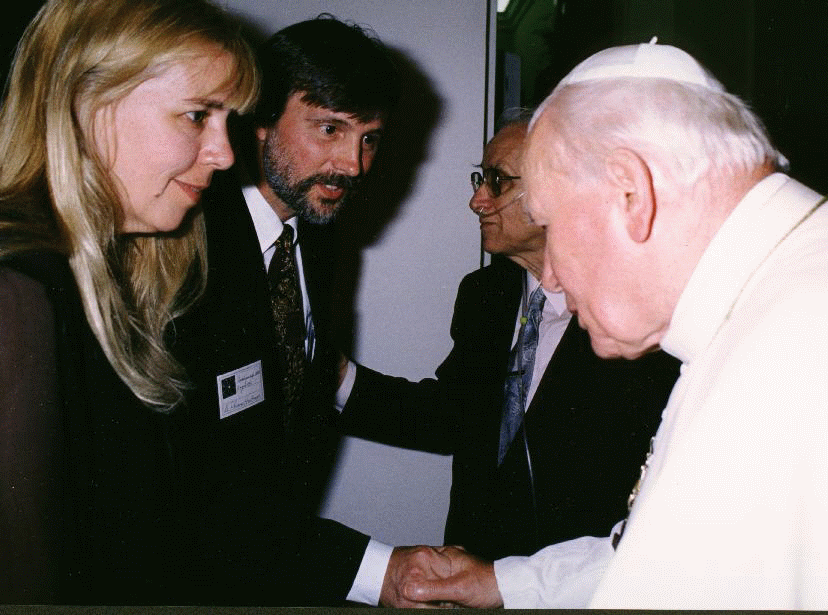
Thom & Louise at a "private audience" with His Holiness Pope John Paul II at his summer palace, Castle Gandolfo, Italy

At Mondragon - both the mountain and the cooperative city - in Spain (written about in "Threshold" book)
From Screwed:
"Thom Hartmann’s book explains in simple language and with concrete research the details of the Neo-con’s war against the American middle class. It proves what many have intuited and serves to remind us that without a healthy, employed, and vital middle class, America is no more than the richest Third World country on the planet."
From The Thom Hartmann Reader:
"Thom is a national treasure. Read him, embrace him, learn from him, and follow him as we all work for social change."
From Unequal Protection, 2nd Edition:
"If you wonder why and when giant corporations got the power to reign supreme over us, here’s the story."

The Dems are Mad as HellBy David Prentice
A few seconds of frustrated political rage in the 1976 movie Network drove the words “I’m mad as Hell, and I’m not going to take this anymore!” into our national collective consciousness. Most Democrats seem to feel that way; they’ve been mad for two years.
So mad, that the very name of Trump causes most Democrats to sputter, many coming to full froth within two sentences.
It’s not a surprise we see this consistent reaction of rage and hatred coming from the Democratic Party leadership, or the leftist mainstream media. The entire group of them does hate Trump, and their pogrom to destroy him has been ramping up into our discourse since Trump declared his candidacy. I think most of us know that they hate us, as well.
Howard Beale Mad.
more here
https://www.americanthinker.com/articles/2018/11/the_dems_are_mad_as_hell.html